Best Online Islamic Classes for Kids – A Complete Guide
Online Islamic classes for kids are virtual programs that teach Islamic principles, Quran recitation, Arabic, and moral values in an engaging, age-appropriate way.
These classes use interactive tools, games, and storytelling to keep young learners interested. Parents appreciate the flexibility and accessibility, especially for families with busy schedules or limited local resources.
Fajr Al-Quran Academy offers programs with live sessions led by certified instructors and structured curricula aligned with Islamic teachings. Also, self-paced digital programs that teach children the Quran, Arabic, and core Islamic principles from home.
Many Muslim parents in the US, UK, Canada, and Australia want their children to grow up with a strong understanding of Islam while keeping up with their regular education.
Online Islamic Classes for Kids offer a practical way to make Islamic learning part of a child’s weekly routine. Children can learn Quran reading, basic Tajweed, Islamic beliefs, daily duas, Salah, and the life of Prophet Muhammad (peace be upon him) from home. With the right teacher, lessons can be engaging, age-appropriate, and easy to follow.
However, not every online course offers the same teaching quality or learning experience. Some focus mainly on Quran recitation, while others provide a broader Islamic studies curriculum. Parents should consider their child’s age, current knowledge, learning goals, and preferred schedule before choosing a program.
This guide explains what children can learn, how online Islamic Classes for Kids work, and what to look for in a trustworthy Islamic learning platform. It also explores how Fajr Al-Quran Academy can support families looking for structured Quran and Islamic education online.
Whether your child is a complete beginner or already reads the Quran, the right learning plan can help build knowledge, confidence, good character, and a lasting connection with Islam.
What Are Online Islamic Classes for Kids?
Online Islamic Classes for Kids are lessons delivered through the internet by teachers who help children learn about Islam. Depending on the program, lessons may take place through live video sessions, virtual classrooms, or a structured learning platform. Children can study from home without needing to travel to a local Islamic school or mosque for every lesson.
These classes are particularly useful for Muslim families living in areas where qualified teachers or suitable Islamic education programs are difficult to access. They can also help parents maintain a consistent learning routine when school, work, and family commitments leave little time for additional travel.
Most programs cover a combination of Quran reading, Islamic beliefs, worship, manners, and the history of Islam. Some introduce children to Noorani Qaida, which helps beginners recognise Arabic letters and develop the skills needed to read Quranic text. Other courses focus on Islamic studies for children who already have basic reading skills.
The learning experience depends on the teacher and course format. Live lessons allow children to ask questions, practise recitation, and receive direct feedback. Recorded resources and worksheets may support revision between sessions.
For beginners, a suitable course should introduce concepts gradually and use simple English when explanations are needed. Lessons should also respect a child’s developmental stage rather than expecting every learner to progress at the same speed.
Ultimately, online Islamic education works best when children receive clear instruction, regular encouragement, and opportunities to practise what they learn. Parents can support this process by discussing lessons at home and helping children maintain a realistic schedule.
Key Features of Online Islamic Classes for Muslim Children
A good online Islamic program should do more than deliver information. It should help children understand lessons, practise essential skills, and develop positive learning habits. Parents should look for a course that combines sound Islamic teaching with an approach suited to young learners.
One important feature is live, interactive instruction. Children learn more effectively when they can speak directly with a teacher, ask questions, and receive corrections during a lesson. Individual attention can be especially valuable for beginners who need help recognising Arabic letters or pronouncing Quranic words.
Other useful features include:
-
Age-appropriate lessons: Content should match the child’s reading ability, attention span, and existing Islamic knowledge.
-
A structured curriculum: Lessons should follow a clear progression instead of covering unrelated topics without a learning plan.
-
Qualified tutors: Teachers should have appropriate Quranic or Islamic studies knowledge and experience teaching children.
-
Flexible scheduling: Families should be able to find lesson times that work around school, homework, and family commitments.
-
Regular feedback: Parents should understand what their child has learned and which areas need more practice.
-
Supportive learning materials: Worksheets, revision activities, quizzes, and simple illustrations can reinforce key ideas.
A welcoming online classroom also matters. Children should feel comfortable asking questions without being embarrassed when they make mistakes. Patient correction and positive reinforcement can encourage them to participate more confidently.
Some online Islamic courses for kids include short activities or games to make lessons enjoyable. These can be helpful when they reinforce the subject rather than distract from it.
Before enrolling, parents should ask how lessons are delivered, whether progress is monitored, and what happens if a child needs additional support. The best program is one that makes learning accessible while maintaining clear educational goals and respect for Islamic teachings.
What Do Kids Learn in Online Islamic Classes?
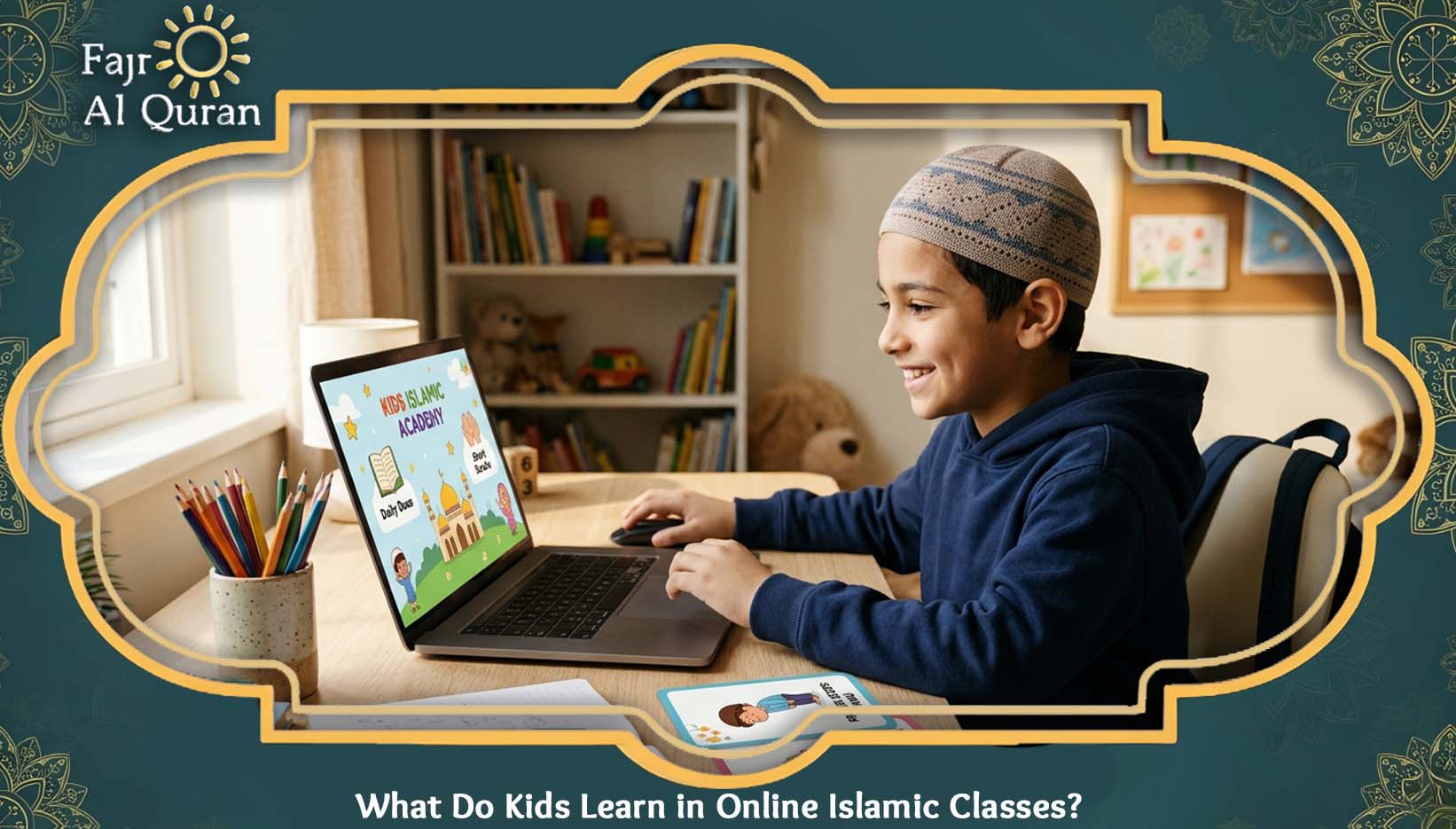
The subjects taught in Online Islamic Classes for Kids vary by age, course level, and learning objectives. A well-planned curriculum introduces essential Islamic knowledge first, then gradually develops a child’s understanding of worship, beliefs, Quranic recitation, and everyday Muslim life.
For younger children, lessons may begin with simple Islamic greetings, short duas, good manners, and an introduction to Allah’s creation. As children develop, they can explore more detailed topics and learn how Islamic teachings guide their daily choices.
Common subjects include:
-
Quran reading: Recognising Arabic letters, connecting letters, reading words, and practising short surahs.
-
Islamic beliefs (Aqeedah): Learning about Allah, the prophets, angels, revealed books, and other foundations of Islamic faith.
-
Worship (Fiqh): Understanding the basics of wudu, Salah, fasting, and other age-appropriate acts of worship.
-
Hadith: Learning selected sayings of Prophet Muhammad (peace be upon him) and their practical lessons.
-
Seerah: Discovering the Prophet’s life, his kindness, patience, honesty, and care for others.
-
Daily duas and manners: Practising supplications and learning respectful behaviour at home, school, and in the community.
Some courses also introduce children to Islamic history and Arabic vocabulary. The exact content should be appropriate for the child’s age and prior knowledge.
For Muslim children growing up in Western countries, these lessons can provide a helpful connection between their family traditions and their everyday experiences. A teacher might discuss honesty at school, kindness towards classmates, or the importance of prayer during a busy day.
Parents should check that the course teaches subjects in a balanced way. Children need more than memorised facts; they benefit from understanding what a teaching means and how to apply it thoughtfully. Regular revision, simple examples, and opportunities to ask questions help turn new information into lasting knowledge.
Learn Aqeedah, Fiqh, Hadith, and Seerah with an Islamic Teacher for Kids
Islamic studies help children understand the beliefs, practices, and moral teachings that shape Muslim life. With a knowledgeable teacher, children can explore these subjects in clear language and gradually develop a stronger foundation in their faith.
Aqeedah introduces children to the essential beliefs of Islam. Lessons may cover belief in Allah, His angels, His revealed books, His messengers, the Last Day, and divine decree. Teachers should explain these concepts carefully, using age-appropriate examples rather than overwhelming children with complicated terminology.
Fiqh helps children learn the practical aspects of worship. Depending on their age and level, they may study cleanliness, wudu, Salah, fasting, and everyday questions about Muslim conduct. Teachers should explain differences between recognised schools of Islamic jurisprudence respectfully when relevant, rather than presenting every secondary issue as universally agreed upon.
Hadith lessons introduce selected teachings of Prophet Muhammad (peace be upon him). Children can discuss themes such as truthfulness, mercy, patience, generosity, and respect for parents. Teachers should use reliable sources and explain the meaning of each narration in context.
Seerah explores the Prophet’s life, including his childhood, the beginning of revelation, his migration to Madinah, and his relationships with family and companions. Stories can help children understand perseverance, compassion, courage, and trust in Allah.
When choosing Online Islamic Classes for Kids, ask whether these subjects are taught systematically or included only occasionally. A clear syllabus helps parents understand what their children will study over time.
The teacher’s approach is equally important. Lessons should invite thoughtful questions, encourage good character, and distinguish established Islamic teachings from personal opinions. This helps children develop a meaningful understanding of Islam instead of simply memorising answers for a class.
Online Quran Classes for Children
Learning to read the Quran is an important goal for many Muslim families. Yet children may need different levels of support depending on whether they are learning the Arabic alphabet, beginning to join letters, or already reading short surahs.
Online Quran classes for children provide a convenient way to practise these skills with a teacher from home. In live lessons, children can read aloud while the tutor listens, identifies mistakes, and demonstrates the correct pronunciation.
Beginners often start with Noorani Qaida or another suitable foundational reading method. They learn Arabic letters, their sounds, vowel marks, and the rules needed to combine letters into words. Once they have developed the necessary skills, they can progress to reading Quranic passages with increasing confidence.
Children who already read the Quran may benefit from lessons focused on fluency, accurate pronunciation, revision, and introductory Tajweed. The teacher should assess the child’s current ability before recommending a suitable level.
When comparing Online Islamic Classes for Kids, parents should consider how Quran instruction fits into the wider curriculum. Some families prefer Quran-focused lessons, while others want Quran reading combined with Islamic studies and daily duas.
A productive learning routine may include:
-
Attending regular live Quran lessons.
-
Reviewing previously learned letters, words, or verses.
-
Practising short passages between sessions.
-
Receiving feedback on pronunciation and reading fluency.
-
Revisiting difficult areas before moving to more advanced material.
Progress should be measured by accuracy and understanding, not simply by how many pages a child completes. Children develop at different rates, and some need more repetition than others.
Parents can help by providing a quiet study space and praising consistent effort. With patient instruction and regular practice, children can build stronger reading habits while developing a closer relationship with the Quran.
Teach Kids Basic Tajweed Rules and Quran Pronunciation
Tajweed is the set of rules that guides the correct recitation of the Quran. It helps readers pronounce Arabic letters accurately and observe the characteristics and recitation rules that preserve the proper form of Quranic recitation.
For children, Tajweed should be introduced gradually. Beginners first need to recognise Arabic letters and understand their sounds. Once they can read basic words, a teacher can introduce relevant rules through demonstrations, guided practice, and repeated recitation.
One important area is Makharij al-Huruf, which refers to the articulation points of Arabic letters. Some Arabic sounds may be unfamiliar to children who mainly speak English at home. A patient teacher can demonstrate where each sound is produced and give the child time to practise.
Other introductory topics may include:
-
Harakat: Short vowel marks that guide pronunciation.
-
Sukoon: A sign indicating that a letter has no vowel.
-
Shaddah: A mark indicating a doubled or strengthened consonant.
-
Madd: Rules related to extending vowel sounds during recitation.
-
Basic rules of noon sakinah and tanween: Introduced when the child is ready to study them.
Online Islamic Classes for Kids can make pronunciation practice easier when the tutor uses clear audio, listens carefully, and gives specific feedback. Parents should check that teachers can explain corrections in language the child understands and can demonstrate sounds clearly over a video call.
It is also important to distinguish between learning basic Tajweed and mastering advanced recitation. Children need time, practice, and appropriate guidance to develop accurate reading.
A supportive teacher focuses on steady improvement rather than making children anxious about mistakes. With regular practice, learners can build better pronunciation, greater confidence, and a stronger foundation for Quran recitation.
How to Choose the Best Online Islamic Course for Kids
Choosing an Islamic course involves more than comparing prices or selecting the first program that appears in a search. Parents need to find a learning environment that suits their child’s needs, teaches reliable Islamic knowledge, and offers a schedule the family can maintain.
Start by identifying your child’s main goal. A beginner may need Arabic letter recognition and basic Quran reading, while an older child may be ready for Seerah, Fiqh, Hadith, or more detailed Islamic studies. If you want a broad education, look for a course that combines these subjects in a clear, age-appropriate curriculum.
Next, evaluate the teacher and teaching method. Ask about qualifications, experience with children, lesson structure, and the way progress is assessed. A teacher should be able to explain difficult concepts simply and adapt instruction when a child needs more time.
Consider these practical questions before enrolling:
-
Curriculum: Which subjects are included, and what will your child learn first?
-
Class format: Are lessons one-to-one or in groups? How much time does each child receive?
-
Schedule: Are lesson times suitable for your local time zone?
-
Progress tracking: Will you receive feedback or updates about your child’s development?
-
Learning support: Are revision materials or homework activities provided?
-
Cost and policies: Are fees, cancellations, missed lessons, and trial-class arrangements explained clearly?
-
Safety: Are child safeguarding expectations, privacy practices, and communication arrangements transparent?
It is sensible to request a trial lesson when available. Observe whether the teacher communicates well, checks the child’s understanding, and creates a comfortable atmosphere.
When comparing Online Islamic Classes for Kids, avoid relying on promotional claims alone. A trustworthy provider should explain its curriculum and teaching approach clearly, without promising instant fluency or guaranteed religious outcomes.
The best course is one that meets your family’s educational goals and encourages steady, meaningful progress.
What Makes a Qualified Online Islamic Teacher for Children?
A qualified online Islamic teacher needs sound subject knowledge and the ability to teach children effectively. Knowing the Quran or Islamic studies well is essential, but teaching young learners also requires patience, clear communication, and an understanding of how children learn.
For Quran lessons, parents can ask about a teacher’s recitation ability, Tajweed training, and relevant qualifications. Teachers offering advanced recitation or Ijazah preparation should have appropriate expertise for that level. For broader Islamic studies, look for knowledge of the subjects being taught and the ability to refer to reliable sources.
Teaching experience is another important consideration. Children may lose concentration, confuse similar Arabic letters, or need the same explanation several times. An effective teacher recognises these challenges and responds calmly instead of rushing the learner.
A strong teacher should also:
-
Explain concepts in simple, age-appropriate language.
-
Use examples and activities that support the lesson objective.
-
Correct pronunciation and misunderstandings clearly and kindly.
-
Encourage questions without embarrassing the child.
-
Adapt lesson pace to the child’s current ability.
-
Communicate learning goals and progress to parents.
-
Maintain appropriate professional boundaries and follow child-safety procedures.
For families in English-speaking countries, an English-speaking tutor may be particularly helpful when children are learning Islamic terminology for the first time. A native Arabic teacher can also support Arabic pronunciation and vocabulary, provided the teacher can explain concepts in a language the child understands.
Before starting Online Islamic Classes for Kids, ask who will teach your child and how the academy checks its teachers’ credentials. Find out how feedback is shared and how concerns can be raised.
A good teacher helps children feel supported while maintaining clear expectations. This balance allows learners to ask questions, correct mistakes, and develop their knowledge with confidence.
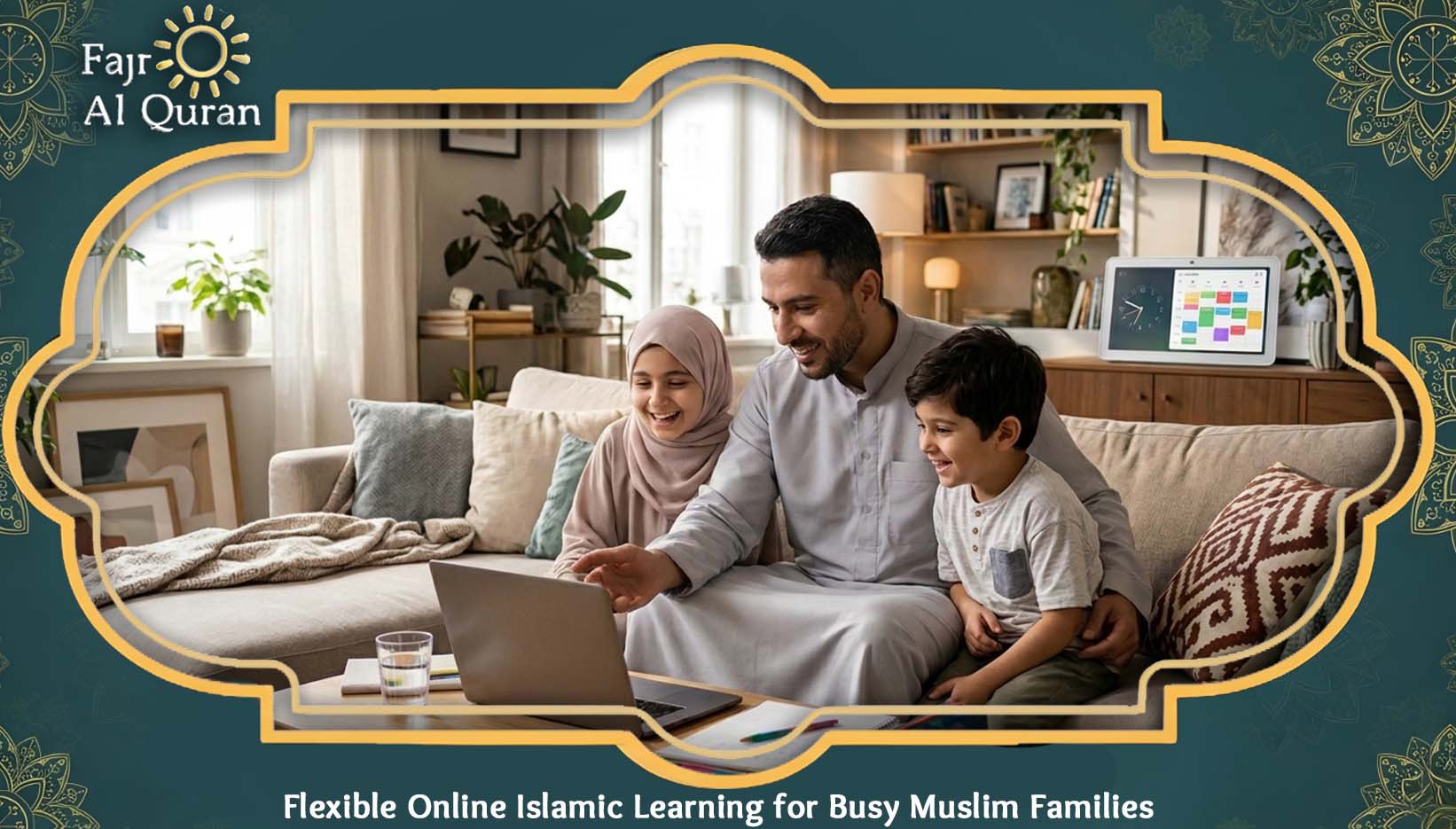
Flexible Online Islamic Learning for Busy Muslim Families
Many Muslim families in the US, UK, Canada, and Australia manage school hours, homework, work commitments, extracurricular activities, and family responsibilities. Adding Islamic education to this schedule can be difficult, particularly when a local mosque or Islamic school offers limited class times.
Online Islamic Classes for Kids can reduce some of these challenges by allowing children to learn from home. Families may be able to arrange live sessions around school and other commitments, depending on the provider’s availability. This can make regular lessons easier to maintain without additional travel.
Flexible learning is especially helpful for families living far from established Muslim communities. It can also support parents who want their children to receive consistent Quran instruction while attending a mainstream school.
However, flexibility should not mean leaving learning entirely unstructured. Children benefit from a predictable routine that includes lesson time, revision, and rest. Parents should choose a schedule that is realistic rather than booking more sessions than their child can comfortably manage.
A simple weekly routine might include:
-
Two or three short Quran or Islamic studies sessions, depending on the child’s needs.
-
Brief revision periods between lessons.
-
A family discussion about one Islamic concept or story each week.
-
Time for play, schoolwork, sleep, and other activities.
The ideal number of lessons depends on the child’s age, concentration, learning goals, and existing commitments. Ask the teacher to recommend a suitable starting schedule and adjust it based on the child’s progress.
Parents should also check the academy’s time-zone options, rescheduling policies, and arrangements for missed lessons. These details can make a real difference for families with changing work shifts or school holidays.
Why Choose Fajr Al-Quran Academy for Your Child’s Islamic Education?
Choosing an online academy is an important decision because your child’s early learning experiences can influence their confidence and interest in Islamic education. Parents should look for a provider that combines structured lessons, knowledgeable teachers, and a supportive approach to learning.
Fajr Al-Quran Academy is an option for families seeking online Quran instruction and Islamic education from home. Its courses can be considered by parents who want to help their children strengthen Quran reading skills and develop a better understanding of Islamic teachings.
When exploring the academy’s programs, parents should identify the subjects that best match their child’s needs. A beginner may need help with Arabic letters and basic Quran reading, while a more experienced learner may benefit from Tajweed practice or additional Islamic studies.
A suitable learning plan should provide clear objectives and allow children to progress at an appropriate pace. Live lessons can give learners opportunities to interact with their tutor, practise what they have learned, and receive feedback on areas that need improvement.
Families considering Fajr Al-Quran Academy should ask about the following details before enrolling:
-
Course options: Which Quran and Islamic studies subjects are available for the child’s age and current level?
-
Teacher selection: What qualifications and experience do the tutors have?
-
Lesson schedules: Are suitable times available for your family’s time zone?
-
Learning progress: How are achievements and areas for improvement communicated to parents?
-
Trial lessons: Can your child attend an introductory session before making a longer-term commitment?
These questions help parents make an informed choice rather than relying on advertising alone. It is also worth checking the current fees, course availability, and enrollment policies directly with the academy.
For parents comparing Online Islamic Classes for Kids, Fajr Al-Quran Academy is worth exploring, as its available programs align with those priorities.
Frequently Asked Questions
1. What is the best age to start online Islamic classes for kids?
Children can begin learning basic Islamic concepts, short duas, and simple Quran skills when they are ready to participate in age-appropriate lessons. The ideal starting age depends on the child’s development, attention span, and learning needs.
2. What do children learn in online Islamic studies classes?
Children may study Quran reading, Tajweed, Aqeedah, Fiqh, Hadith, Seerah, Salah, daily duas, and Islamic manners. The subjects covered depend on the course, the child’s age, and their existing knowledge.
3. Are online Islamic classes effective for children?
Online classes can support children’s learning when lessons are well structured, teachers provide feedback, and learners practise regularly. Parents can improve the experience by providing a quiet study space and encouraging revision between sessions.
4. How can I choose the best online Islamic classes for my child?
Compare the curriculum, teacher qualifications, class format, scheduling options, safeguarding practices, and fees. If a trial lesson is available, use it to assess whether the teaching style suits your child.
Conclusion: Help Your Child Build a Strong Islamic Foundation
Children benefit from learning about Islam in an environment that combines reliable knowledge, patient teaching, and regular practice. The right program can help them improve Quran reading, understand essential beliefs and acts of worship, and develop good character.
Online Islamic Classes for Kids give families a practical way to make Islamic education part of everyday life, even when local classes or family schedules present challenges. By choosing a suitable curriculum and staying involved in your child’s progress, you can help make learning meaningful and enjoyable.
Fajr Al-Quran Academy is one option to explore as you compare online Quran and Islamic studies programs for your family.
Ready to take the next step? Contact Fajr Al-Quran Academy to ask about available courses and book a free trial lesson with a suitable Quran teacher. Help your child begin learning with confidence and build a stronger connection with Islam, one lesson at a time.