Invalidate and Break Wudu: Complete Guide to What Breaks Wudu

Learn Wudu and Quran Online with Expert Teachers
Ready to strengthen your Islamic knowledge? Join Fajr Al-Quran Academy today and learn Quran, Tajweed, Arabic, and essential Islamic studies online with qualified teachers. Start learning from home and build confidence in your worship step by step.
Enroll today and begin your Quran learning journey!
What Does It Mean to Invalidate and Break Wudu?
To invalidate and break wudu means that a person is no longer considered to be in the state of ritual purity established by ablution.
When a recognized nullifier occurs, the previous wudu ends. The person must perform ablution again before an act of worship that requires wudu, such as prayer.
The Arabic term wuḍū refers to the ritual ablution performed by Muslims.
It is not simply washing the body for cleanliness.
It is an act of worship performed according to a specific method.
The Quran describes purification before prayer in Surah Al-Ma’idah, 5:6, including washing the face, arms, wiping the head, and washing the feet.
The rules of wudu are therefore connected to both physical purification and obedience to Allah.
A Muslim should learn them as part of their deen.
It is also important to understand the difference between a condition and a nullifier.
A condition is something required for wudu to be valid, such as using pure water when water is available and appropriate.
A nullifier is an event that causes existing wudu to end.
When something breaks wudu, the Muslim does not need to feel anxious.
They simply renew their ablution. Learning when actions invalidate and break wudu gives a Muslim confidence and helps them prepare for prayer correctly.
Why Is It Important to Know What Invalidates and Breaks Wudu?
Knowing what invalidates and breaks wudu is important because wudu is closely connected with salah.
Prayer has conditions that must be fulfilled, and ritual purity is one of them.
A Muslim who understands these rules can avoid praying without the required purification.
For beginners, learning the nullifiers of wudu is also one of the foundations of Islamic studies.
It helps a new Muslim understand how daily worship works. Children can learn the basic rules gradually.
Adults can also review them when they are unsure about a particular situation.
Another important reason is to avoid unnecessary doubt. Islam does not require a person to repeat wudu simply because they imagine that it may have been broken.
There is a well-known principle in Islamic jurisprudence that certainty is not removed by doubt.
If you know that you made wudu and only suspect that something happened, you should not automatically assume that your wudu is gone.
The Sunnah gives an important example.
The Prophet Muhammad ﷺ taught that a person should not leave prayer because of mere uncertainty unless they are sure that something happened.
This principle protects Muslims from excessive doubts.
Reliable learning is especially useful because some factors that invalidate wudu are agreed upon, while others have different rulings among scholars.
Resources such as IslamQA discuss these differences under their material on the nullifiers of wudu.
The goal is not simply to memorize a list. The goal is to understand the principles and apply them correctly.
Common Things That Invalidate and Break Wudu
Several events are widely recognized as nullifiers of wudu.
The clearest examples involve something leaving the front or back private passages.
Urine, stool, and passing wind are among the most familiar examples.
These events invalidate the existing ablution, so the person should clean themselves as required and perform fresh wudu.
Sleep can also break wudu when it is deep enough that a person loses awareness.
The details of this ruling differ according to the situation and scholarly interpretation.
A short period of light sleep while remaining aware may not have the same ruling as deep sleep.
Another important issue involves sexual fluids. Passing madhy requires washing the affected area and renewing wudu.
The emission of semen with sexual pleasure is associated with major ritual impurity and generally requires ghusl rather than wudu alone.
Bleeding, vomiting, and similar events require more care.
Scholars have differed about whether these things themselves invalidate wudu.
For example, scholars differed over blood and vomiting, with some schools considering certain cases to invalidate wudu and others not treating ordinary bleeding as a nullifier.
This is why Muslims should avoid creating an absolute list from an uncertain source.
If a situation is disputed, learn which madhhab or scholarly position you follow.
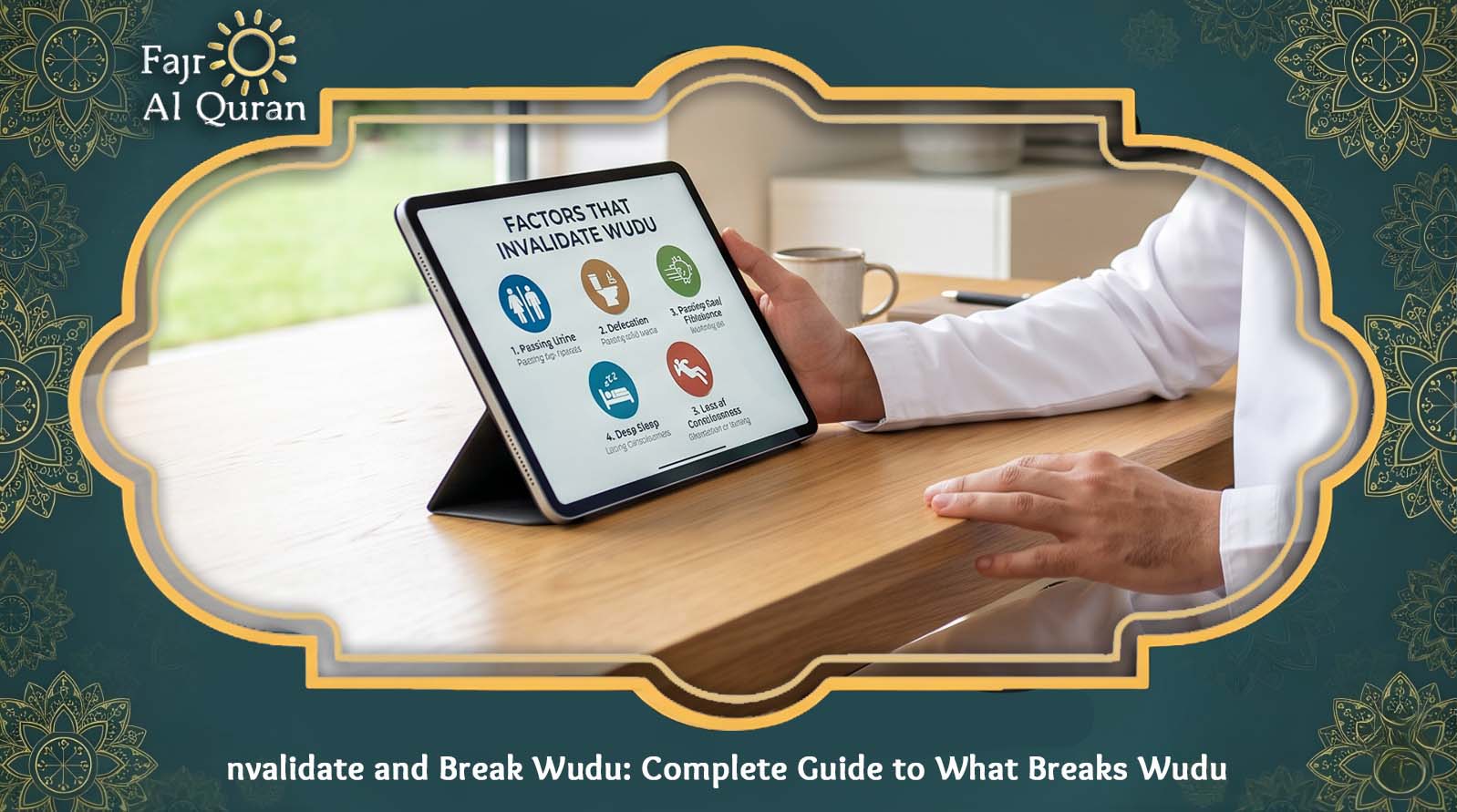
The main events that can invalidate and break wudu include:
- Urination or defecation.
- Passing wind.
- Deep sleep or loss of consciousness.
- Certain sexual discharges.
- Conditions involving the front or back passages.
- Other disputed matters according to the school of Islamic jurisprudence being followed.
Learning these situations makes daily worship easier.
You can then recognize when you need to perform ablution instead of worrying about every ordinary action.
Main Actions That Invalidate and Break Wudu
The main actions that invalidate and break wudu usually involve bodily discharge, loss of awareness, or entering a state of ritual impurity.
Understanding these categories is more useful than memorizing random events.
Using the toilet is one of the clearest examples. Urine and stool invalidate wudu.
After using the bathroom, a Muslim should clean the private area properly and then perform wudu before prayer.
Passing gas also breaks wudu, even if there is no visible impurity.
Loss of consciousness is another important category.
If a person becomes unconscious, heavily intoxicated, or loses normal awareness, their previous wudu is no longer valid.
Deep sleep has the same effect because a person may not know what happened while asleep.
Sexual discharge requires attention to the type of discharge.
Madhy invalidates wudu and requires cleaning the affected area.
Semen, when emitted in circumstances requiring major purification, requires ghusl.
These distinctions are part of the basic fiqh of purification.
Touching the opposite sex is an area where the rulings differ.
Some scholars hold that physical contact itself does not invalidate wudu unless accompanied by a relevant discharge, while other schools have more specific rulings concerning certain types of touching.
Therefore, a beginner should not assume that every physical contact automatically breaks wudu.
Bleeding is also discussed differently by scholars. Some jurists consider significant bleeding a nullifier, while other scholars do not.
This disagreement explains the evidence used by scholars on both sides.
The safest approach is to learn the position of a trusted, qualified scholar or recognized madhhab rather than following random online answers.

Difference between Islamic legal schools (Madhhabs) on what actions invalidate and break wudu
Difference between Islamic legal schools (Madhhabs)
| Scenario / Action | Hanafi | Maliki | Shafi’i | Hanbali |
|---|---|---|---|---|
| Bleeding / Pus (from anywhere other than private parts) | Breaks wudu if it flows beyond the point of exit. | Does not break wudu. | Does not break wudu. | Breaks wudu only if it is a large/excessive amount. |
| Vomiting | Breaks wudu if it fills a “mouthful”. | Does not break wudu. | Does not break wudu. | Breaks wudu only if it is a large/excessive amount. |
| Touching Your Own Private Parts | Does not break wudu. | Breaks wudu if touched directly with the palm or inside of fingers. | Breaks wudu if touched directly with the palm or inside of fingers. | Breaks wudu if touched directly with any part of the hand. |
| Skin Contact with the Opposite Gender | Does not break wudu, unless it involves actual sexual intercourse. | Breaks wudu if the touch is accompanied by sexual desire/lust. | Breaks wudu upon direct skin contact between a marriageable man and woman, regardless of desire. | Breaks wudu if the touch is accompanied by sexual desire/lust. |
| Deep Sleep | Breaks wudu based on posture; it breaks if lying down or leaning, but not if firmly seated. | Breaks wudu based on depth; heavy/deep sleep breaks it regardless of posture. | Breaks wudu unless one is firmly seated on the ground. | Breaks wudu unless it is a very short sleep while standing or sitting. |
| Eating Camel Meat | Does not break wudu. | Does not break wudu. | Does not break wudu. | Breaks wudu definitively. |
| Laughing Aloud During Prayer | Breaks both the wudu and the prayer, provided it is loud enough for others to hear. | Breaks the prayer, but does not break the wudu |
What Invalidates and Breaks Wudu for a Woman?
The basic rules of wudu apply to women and men.
However, women may experience situations that require additional knowledge, especially menstruation, post-natal bleeding, and ongoing vaginal discharge.
Menstruation and post-natal bleeding are not simply ordinary wudu nullifiers.
They involve a state of major ritual restriction with their own rulings.
When menstruation begins, ordinary wudu does not allow a woman to perform salah.
When the menstrual period ends, she performs ghusl before returning to prayer.
Non-menstrual bleeding, known as istihaadah, is different.
It does not have the same ruling as menstruation.
Classical Islamic sources discuss purification for a woman experiencing ongoing istihaadah.
Hadith concerning Fatimah bint Abi Hubaysh explains the ruling that she performs wudu for each prayer in the relevant circumstances.
Vaginal discharge is another subject where details matter.
Scholars have discussed whether different types of discharge are pure or impure and whether they require renewed wudu.
Some rulings depend on the source and nature of the discharge.
Records scholarly discussion concerning ordinary vaginal discharge and continuous discharge.
A woman should therefore avoid assuming that every type of fluid has the same ruling.
If the issue happens frequently, asking a qualified scholar can prevent unnecessary hardship.
Women should also remember that menstruation does not prevent them from remembering Allah or making dua.
Scholarly views differ on some details concerning Quran recitation during menstruation, so learners should follow a reliable scholarly position.
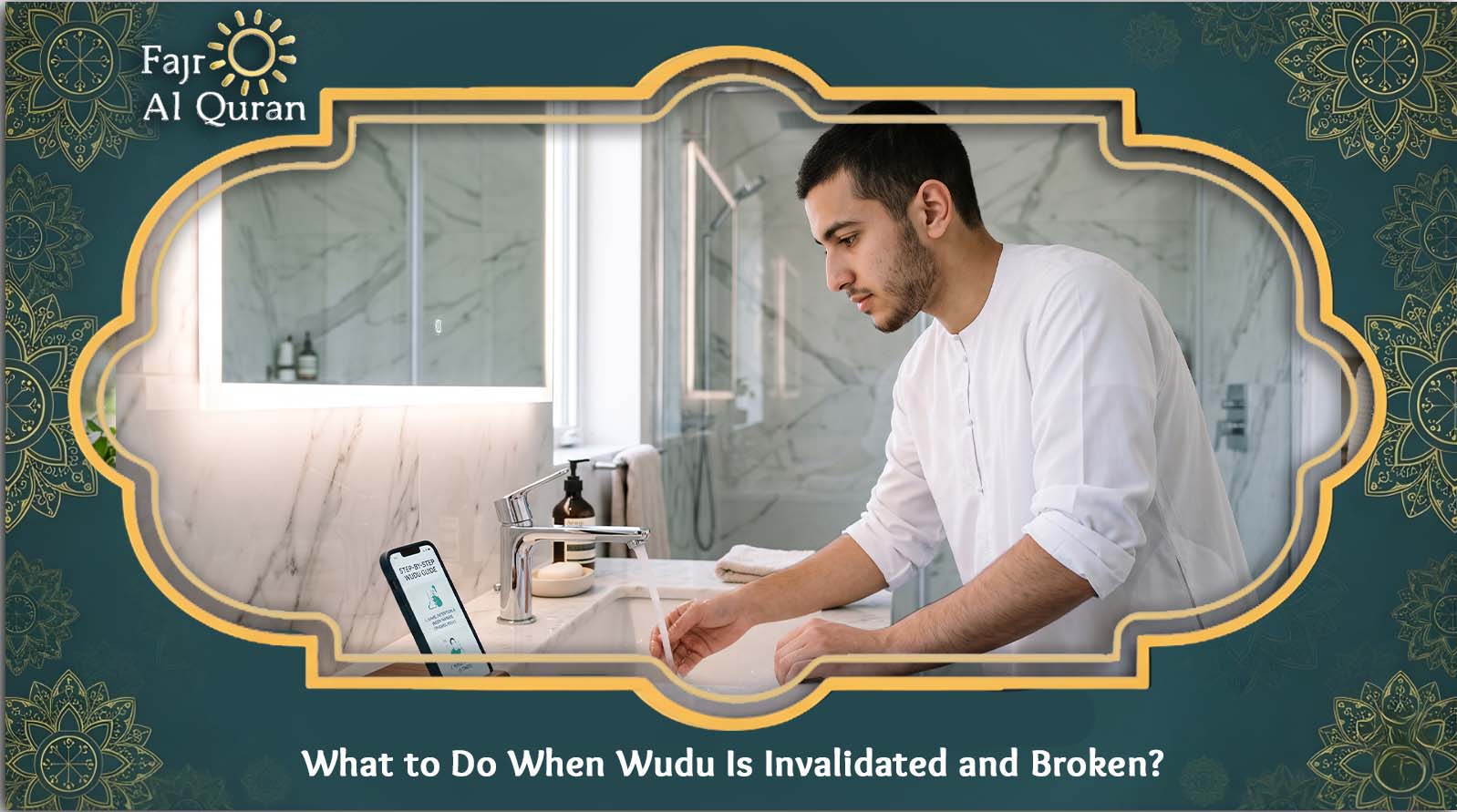
What to Do When Wudu Is Invalidated and Broken?
When you know that your wudu has been invalidated, the solution is straightforward: renew your ablution before performing an act of worship that requires wudu.
First, identify what happened. If you used the bathroom or passed wind, clean yourself when necessary.
Then perform wudu according to the Sunnah.
If water is unavailable or its use would cause genuine harm under the relevant Islamic conditions, the rules of tayammum may apply.
A complete wudu involves washing the required body parts in the correct manner.
A Muslim should make the intention for purification, wash the face, wash the arms up to the elbows, wipe the head, and wash the feet according to the established method.
If you are not sure whether your wudu broke, do not automatically repeat it.
For example, if you clearly remember making wudu but only wonder whether you passed wind, uncertainty alone does not mean that the wudu is invalid.
The principle of certainty is important here.
If you repeatedly experience a condition that breaks wudu, such as ongoing istihaadah or another continuing discharge, the ruling can be different from an occasional event.
Such a person may have a special concession in Islamic law and should learn the appropriate procedure from a qualified scholar.
For beginners, the best way to learn is through structured Islamic education.
Fajr Al-Quran Academy can be a useful place to study Quran, Arabic, Tajweed, and foundational Islamic knowledge online with teachers. Learning these subjects together can make religious practice easier to understand.
The key lesson is simple: when a recognized nullifier occurs, renew your wudu and continue your worship without unnecessary anxiety.
Frequently Asked Questions About What Breaks Wudu
Does passing wind invalidate wudu?
Yes. Passing wind is one of the commonly recognized events that breaks wudu.
A person should renew their ablution before prayer.
Does urinating or defecating break wudu?
Yes. Urine and stool coming from the normal private passages invalidate wudu.
The person should clean themselves and then perform fresh ablution.
This is among the clearest nullifiers discussed in Islamic law.
Does sleeping invalidate wudu?
It depends on the type and depth of sleep.
Deep sleep can invalidate wudu because a sleeping person may lose awareness of what happens. Light sleep, while a person remains aware,e may have a different ruling.
Does bleeding break wudu?
There is a scholarly difference. Some jurists consider certain amounts or types of bleeding to invalidate wudu, while others do not consider ordinary bleeding a nullifier.
Therefore, follow the position of the qualified scholar or madhhab you rely upon.
Does vomiting invalidate wudu?
There is also scholarly disagreement about vomiting. Some scholars considered certain vomiting to invalidate wudu, while others regarded it as not nullifying wudu.
This is an example of why learners should study fiqh from a reliable source rather than assuming every online list represents unanimous Islamic law.
Does touching someone break wudu?
Touching another person is a matter of scholarly disagreement.
Different schools have different rulings concerning physical contact, especially between men and women.
The circumstances and intention can also affect the discussion. Ask a qualified scholar if you need a ruling for a specific situation.
Does menstruation break a woman’s wudu?
Menstruation is more than an ordinary wudu nullifier.
During menstruation, a woman follows the specific rulings of menstruation.
Once the period ends, she performs ghusl before returning to prayer.
What if a woman has continuous discharge?
A woman with continuous discharge may have a ruling similar to a person with an ongoing condition that repeatedly nullifies wudu.
The details depend on the type of discharge and the circumstances.
Scholarly sources discuss special procedures for ongoing conditions.
Do I need to repeat wudu because I have doubts?
Not necessarily.
If you are certain that you made wudu and only doubt whether it was broken, you should not treat doubt as certainty.
Islam teaches ease and does not require Muslims to fall into unnecessary hardship.
Where can beginners learn the rules of wudu?
Beginners can study purification through reliable Islamic studies courses, qualified teachers, and recognized scholarly resources.
Fajr Al-Quran Academy offers online learning in Quran and related Islamic subjects, making it possible for children and adults to study from home.
Is there a difference between wudu and wudhu?
No. “Wudu,” “wudhu,” and “wuḍū” are different English transliterations of the Arabic term وضوء.
They refer to the same Islamic practice of ritual ablution.
What are the key wudu conditions and nullifiers?
The conditions concern what is required for valid purification, while nullifiers are events that end an existing state of wudu.
Learning both is essential for Muslims who want to perform prayer correctly.
Can online Islamic studies help me learn wudu?
Yes. Online learning can provide a structured way to learn purification, prayer, Quran, Arabic, and other areas of Islamic studies.
A qualified teacher can also correct practical mistakes and explain differences between scholarly opinions.
Final Thoughts
Understanding what can invalidate and break wudu is an important part of learning Islam.
Wudu prepares a Muslim for prayer and reminds us of the importance of purity, discipline, and worship.
The basic nullifiers are not difficult to learn. Urination, defecation, passing wind, deep loss of awareness, and certain sexual discharges are among the main matters to understand.
At the same time, not every issue has one universally accepted ruling.
Questions about bleeding, vomiting, touching another person, and certain types of discharge may involve differences among Islamic scholars and schools of fiqh.
This is why a good Muslim should learn from reliable sources and qualified teachers.
Fajr Al-Quran Academy provides an opportunity for students to study Quran, Arabic, Tajweed, and Islamic studies online.
Building these foundations can help Muslims understand their deen and practice it with greater confidence.