Difference Between Hafs and Warsh Quran Guide
Hafs and Warsh are two canonical styles of Quranic recitation (qirā’āt). The difference between the Hafs and Warsh Quran in pronunciation rules, vowel placements, and minor phonetic details rather than core theological messages. Hafs is the global standard used by roughly 95% of Muslims, while Warsh is predominantly used in North Africa.
Many Muslims are surprised when they hear two people recite the Qur’an slightly differences between them. One person may pronounce certain words differently, while another may pause or elongate a sound in another place. The short answer is reassuring. There is only one Quran, and every authentic Quran recitation traces back to the Prophet Muhammad ﷺ through reliable chains of transmission. The difference between Hafs and Warsh Quran is not a difference in the message of Islam. Rather, it reflects authentic methods of reciting the same revealed words according to the science of Qira’at.
Hafs and Warsh are two authentic and widely accepted methods (riwayat) of reciting the Quran, originating from different transmission chains. They differ mainly in geographic popularity, pronunciation rules (Tajweed), and slight variations in vowels or letters that do not change the core meaning.
Learning about Hafs vs Warsh helps students appreciate the depth of Islamic scholarship and the careful preservation of Allah’s Book. Whether you are a beginner, a parent, a new Muslim, or someone looking to learn Quran online, understanding these recitations will strengthen your confidence in the authenticity of the Quran.
In this guide, we will explain the history of the Qira’at, introduce Imam Hafs and Imam Warsh, compare their recitations, and help you decide which recitation is most suitable for your learning journey.

Start Your Quran Learning Journey Today
Whether you’re beginning with the Hafs narration, learning the Warsh recitation, or simply exploring the beauty of the Quran for the first time, studying with qualified teachers can make your journey easier and more rewarding.
Book your free trial class today and discover how our expert guidance can help you recite the Quran correctly, understand its beauty, and build a lifelong connection with the words of Allah.
What Are the Qira’at of the Quran?
The Arabic word Qira’at (قراءات) means “methods of recitation.” It refers to the authentic ways of reciting the Quran that were taught by the Prophet Muhammad ﷺ and transmitted through trustworthy scholars over many generations.
The Prophet ﷺ received the Quran from the Angel Jibreel (Gabriel) and taught it to his Companions. Since the early Muslim community included tribes with different Arabic dialects, Allah allowed the Quran to be recited in several authentic forms. These variations made the revelation easier for different tribes to learn while preserving the same divine message.
Over time, Muslim scholars carefully documented these recitations. They examined every chain of narration, verified every pronunciation, and ensured that each recitation matched the written text of the Uthmanic Mushaf. Only the recitations that fulfilled strict scholarly conditions were accepted.
Today, Muslims commonly refer to the Seven Qira’at, which were compiled by the famous scholar Ibn Mujahid in the fourth Islamic century. Later scholars recognized Ten Qira’at, all of which meet the accepted conditions of authenticity. Each Qira’ah has its own chain of narrators and precise rules of pronunciation, while remaining fully consistent with the Quran revealed to the Prophet ﷺ.
Every authentic Qira’ah shares several important characteristics:
- It has a reliable chain of transmission back to the Prophet Muhammad ﷺ.
- It agrees with the Uthmanic written script of the Quran.
- It follows correct classical Arabic.
- It has been accepted by qualified scholars throughout Islamic history.
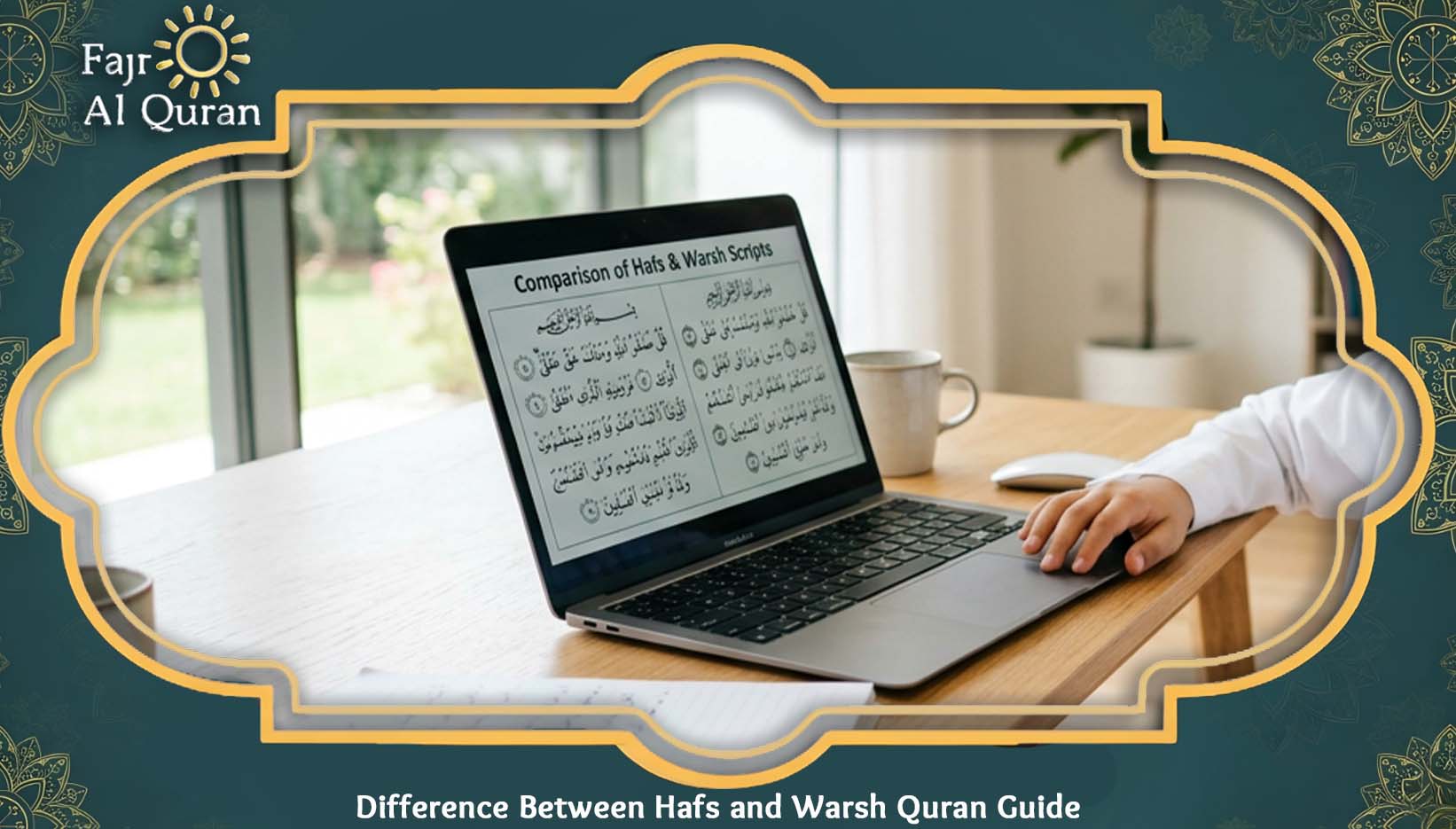
The difference between Hafs and Warsh in Quran recitations
These recitations are not separate versions of the Quran. Instead, they are authentic Quran readings that preserve the richness and flexibility of the Arabic language. Small differences between Hafs and Warsh Quran may appear in pronunciation, vowelization, or grammatical forms, but the essential teachings and guidance of the Quran remain unchanged.
Understanding the Ten Qira’at also helps students appreciate the remarkable effort Muslim scholars made to preserve the Quran. Every letter, pause, elongation, and pronunciation was transmitted with extraordinary care. This meticulous preservation is one of the reasons the Quran has remained unchanged for over fourteen centuries.
For beginners, learning about the Qira’at removes unnecessary confusion. Rather than seeing different recitations as contradictions, students begin to recognize them as complementary expressions of the same divine revelation.
Difference Between Hafs and Warsh Quran
Many people who hear about different Quran recitations wonder whether the difference between Hafs and Warsh Quran means there are different versions of the Quran. The answer is no. Both narrations preserve the same revelation and were transmitted through authentic chains back to the Prophet Muhammad ﷺ.
The differences are carefully preserved aspects of the science of Qira’at. They include pronunciation, vowelization, rules of Tajweed, and a small number of word forms that enrich the language of the Quran without changing its message.
The following table summarizes the main differences.
| Aspect | Hafs Quran | Warsh Quran |
| Narrator | Imam Hafs from Imam Asim | Imam Warsh from Imam Nafi’ |
| Pronunciation | The most familiar pronunciation for many Muslims | Slightly different pronunciation in certain words and letters |
| Vowelization | Uses one set of authentic vowel patterns | Uses another authentic set in some verses |
| Tajweed Rules | Follows Hafs-specific rules in certain places | Includes some different rules of lengthening, imalah, and pronunciation |
| Word Variations | A small number of words are read differently | Uses other authentic readings reported from the Prophet ﷺ |
| Meaning | Preserves the intended meaning of the Quran | Preserves the same guidance with complementary linguistic shades |
| Geographic Usage | Common in most Muslim countries | Common in Morocco, Algeria, Mauritania, and much of West Africa |
| Ease for Beginners | Usually easier because learning resources are widely available | Equally authentic but less commonly taught outside Warsh-speaking regions. |
Difference Between Hafs and Warsh Quran in Pronunciation
One of the first differences students notice is pronunciation. Some vowels are read differently, and certain words may be lengthened or pronounced with a slightly different articulation.
These differences follow strict scholarly rules. They are not personal preferences or regional accents. Every pronunciation has been transmitted through reliable chains of narration.
For students taking a tajweed course, these differences demonstrate the precision with which the Quran has been preserved.
Vowelization and Grammatical Forms
Another difference appears in vowel markings.
Arabic words often change their grammatical function through vowel endings. In a limited number of verses, Hafs and Warsh use different authentic vowelizations that fit the Uthmanic script.
These variations enrich the Arabic language while preserving the overall meaning of the verse.
Tajweed Differences Between Hafs and Warsh Quran
Students studying advanced Quran recitation learn that each narration has its own detailed Tajweed characteristics.
Examples include:
- Different rules for vowel length (Madd).
- Slight differences in stopping and continuing.
- Imalah (a leaning pronunciation) in selected words within Warsh.
- Variations in the pronunciation of Hamzah in certain places.
Scholars carefully document differences between Hafs and Warsh Quran, and qualified teachers teach them to their students.
Word Variations
Perhaps the most discussed aspect of Hafs vs Warsh is that a small number of words are read differently.
These are not additions or omissions. The Prophet Muhammad ﷺ taught these authentic readings, and trusted scholars preserved them through different chains of transmission.
In many cases, both readings complement one another by highlighting different shades of meaning within the same verse.
Do Hafs and Warsh Change the Meaning of the Quran?
This is one of the most common questions asked by new Muslims and beginners.
The simple answer is no.
The differences between Hafs and Warsh Quran do not produce different religions, different beliefs, or different messages. Both narrations teach the same faith, the same acts of worship, and the same guidance from Allah.
Instead, the variations fall into several categories.
First, many differences involve pronunciation only. A reader may pronounce a word slightly differently while keeping the same meaning.
Second, some differences involve grammar or word forms. These often add richness to the Arabic language without changing the message of the verse.
Third, a few variations provide complementary meanings. Rather than contradicting one another, they expand the understanding of the verse.
Classical scholars explained that these authentic readings demonstrate the remarkable flexibility and eloquence of the Quranic Arabic language. The Prophet Muhammad ﷺ taught every accepted reading, and trustworthy scholars faithfully transmitted it through the generations.
The preservation of these readings also highlights the care with which Muslims preserved the Quran. Qualified Quran teachers and students memorized, taught, reviewed, and passed down every authentic Qira’ah over many centuries.
This is why mainstream Sunni scholarship accepts both Hafs and Warsh as authentic Quran recitations.
Examples of Differences Between Hafs and Warsh Quran
Looking at a few authentic examples helps students understand that the variations are small and carefully preserved.
Example 1: Surah Al-Fatihah (1:4)
Hafs
مَالِكِ يَوْمِ الدِّينِ
Transliteration
Māliki Yawmid-Dīn
Translation
“Master of the Day of Judgment.”
Warsh
مَلِكِ يَوْمِ الدِّينِ
Transliteration
Maliki Yawmid-Dīn
Translation
“King of the Day of Judgment.”
Explanation
Both descriptions are true of Allah. He is both the Master and the King of the Day of Judgment. The two authentic readings complement each other and provide a fuller understanding of Allah’s majesty.
Example 2: Surah Al-Baqarah (2:125)
Hafs
وَاتَّخِذُوا
Transliteration
Wattakhidhū
Translation
“And take…”
Warsh
وَاتَّخَذُوا
Transliteration
Wattakhadhū
Translation
“And they took…”
Explanation
The two authentic readings highlight different grammatical perspectives within the same passage. Scholars explain that both are part of the revealed recitations and together enrich the interpretation of the verse.
Example 3: Surah Al-Baqarah (2:184)
Hafs
مِسْكِينٍ
Transliteration
Miskīn
Translation
“A needy person.”
Warsh
مَسَاكِين
Transliteration
Masākīn
Translation
“Needy people.”
Explanation
The legal understanding remains the same because scholars interpret the verse alongside other authentic Quran readings and Prophetic teachings. The variation reflects linguistic richness rather than contradiction.
Example 4: Pronunciation Differences
In several places throughout the Quran, Hafs and Warsh differ in the length of certain vowels or the pronunciation of Hamzah.
These changes do not alter the translation. Instead, they reflect different authentic methods of recitation preserved through the science of Qira’at.
Students usually notice these distinctions only after studying Tajweed with an experienced Quran teacher.
What Can We Learn from Examples of Hafs and Warsh Quran?
These examples show several important facts:
- Every authentic reading comes through a reliable chain of narration.
- The differences are limited and carefully preserved.
- The message of the Quran remains unchanged.
- The variations demonstrate the richness of classical Arabic.
- Both Hafs and Warsh trace directly back to the Prophet Muhammad ﷺ.
For beginners, these examples should increase confidence rather than create confusion. The existence of authentic Quran readings is evidence of careful preservation, not inconsistency. Every accepted recitation has been transmitted with extraordinary precision for more than fourteen centuries.
Which Quran Recitation Should You Learn?
If you are just beginning your Quran journey, you may wonder whether you should study Hafs or Warsh first. The good news is that there is no wrong choice. Qualified Quran scholars transmitted and preserved both authentic recitations through reliable chains of narration back to the Prophet Muhammad ﷺ.
For most beginners, however, learning the Hafs narration is the most practical option. Many countries teach this recitation as the standard, while publishers, Quran apps, and online learning platforms rely on this narration for most printed Qurans and digital learning resources. This makes it easier to find qualified teachers and continue your studies without confusion.
If you live in Morocco, Algeria, Mauritania, or parts of West Africa, you may naturally learn the Warsh narration because it is the standard recitation in those communities. Many children memorize the Quran in Warsh from an early age and continue using it throughout their lives.
Your choice may also depend on your goals:
- Complete beginners often benefit from starting with Hafs because learning materials are widely available.
- Students living in Warsh-speaking regions usually learn Warsh to match their local mosques and teachers.
- Quran memorization students should remain consistent with one narration until they complete their memorization.
- Advanced students may later study additional Qira’at to deepen their understanding of the Quran and classical Arabic.
- Those pursuing Islamic studies often learn more than one narration under qualified scholars.
Whichever narration you choose, consistency is important. Learning from a qualified Quran teacher ensures that your pronunciation, Tajweed, and memorization are accurate from the beginning.

Benefits of Learning Different Qira’at
After building a strong foundation in one recitation, many students enjoy exploring other authentic Qira’at. Not every Muslim needs to study more than one narration, but doing so offers many educational benefits
Some of the key benefits include:
- A deeper appreciation of the linguistic beauty of the Quran.
- Stronger understanding of Tajweed and Arabic pronunciation.
- Greater awareness of the history of Quran preservation.
- Better preparation for advanced Islamic studies.
- Improved ability to understand classical Quran commentaries.
- Increased confidence when hearing different authentic recitations.
- A broader appreciation of the diversity preserved within the Islamic scholarly tradition.
Learning different Quran readings also helps students recognize that Islamic scholars have preserved the religion through careful transmission and verification. Every authentic narration has been studied, memorized, and taught by generations of scholars who dedicated their lives to preserving the words of Allah exactly as they received them.
For students interested in the Ten Qira’at, studying under experienced teachers is essential. Each narration has detailed rules that cannot be mastered through reading alone.
Learn Quran with Qualified Teachers Online
Whether you choose Hafs or Warsh, the most important step is learning from a qualified teacher who has studied the Quran through an authentic chain of transmission.
At Fajr Al-Quran Academy, students receive structured Quran education from certified teachers who specialize in Quran recitation, Tajweed, and memorization. Our teachers design lessons for children, adults, new Muslims, and families seeking flexible online learning.
Students can benefit from:
- One-to-one live Quran classes.
- Certified male and female Quran teachers.
- Step-by-step Tajweed instruction.
- Quran memorization programs with regular revision.
- Flexible schedules for learners in the USA, UK, Canada, Australia, and other countries.
- Personalized learning plans based on each student’s level and goals.
Learning online also allows students to study from home while receiving direct feedback on pronunciation and recitation. This personal guidance helps learners avoid mistakes and build confidence as they progress.
Whether your goal is to read the Quran fluently, improve your Tajweed, memorize the Quran, or explore the science of Qira’at, studying with experienced teachers provides a strong foundation for lifelong learning.
Conclusion
Understanding the difference between Hafs and Warsh Quran helps remove one of the most common misunderstandings about the Quran.
These are not different versions of Allah’s Book. They are authentic methods of Quran recitation that were taught by the Prophet Muhammad ﷺ and preserved through reliable chains of transmission.
The differences between Hafs and Warsh involve pronunciation, Tajweed, and a limited number of linguistic variations that enrich the Arabic language without changing the Quran’s message or beliefs.
If you are ready to begin or continue your Quran journey, consider studying with experienced teachers through a trusted Fajr Al-Quran Academy.