
Juz Amma Memorization for Kids: A Step-by-Step Guide for Parents
Juz Amma memorization for kids refers to teaching children the first juz (section) of the Quran, specifically the first 30 pages, which are among the shortest and most accessible verses. This practice helps young learners build a strong foundation in Quranic recitation, pronunciation, and understanding. Juz Amma memorization for kids fosters spiritual connection, discipline, and confidence in early Islamic education. Many programs use interactive methods like songs, games, and visual aids to make memorization engaging and age-appropriate.
You want your child to love the Quran. You hear them mumble a few short surahs, and you wonder: where do we start, how do we stay consistent, and who can guide us, especially when school, activities, and a non-Muslim-majority environment compete for every spare minute?
If that sounds like your home, you are in the right place. This guide walks you through Juz Amma memorization for kids: what it is, the best age to begin, which surahs to learn first, a simple weekly plan, tajweed basics, motivation, and revision. Any child can begin, and consistency matters far more than speed.
At Fajr Al-Quran Academy, we work with families across the US, UK, Canada, and Australia, so everything below is designed for real Western family life. Let’s begin.
What Is Juz Amma and Why Is It the Best Starting Point for Children?
What Juz Amma Contains
Juz Amma is the 30th and final part (juz) of the Quran. It runs from Surah An-Naba (chapter 78) to Surah An-Nas (chapter 114), a total of 37 short surahs. Many families also teach Surah Al-Fatihah alongside it, even though Al-Fatihah sits at the start of the Quran, because children recite it in every prayer.
Why Parents Start With Juz Amma Memorization for Kids
There are good reasons almost every Quran teacher begins here:
- The surahs are short. Many have only three to six verses, so a child can finish one in days and feel a real sense of accomplishment.
- They are used in daily prayer. Surahs like Al-Ikhlas, Al-Kawthar, and Al-Asr are recited in salah, so memorization quickly becomes practice.
- They are rhythmic. The short, punchy verses are easier for young ears and tongues to repeat.
- Confidence builds momentum. Each finished surah is a visible win that keeps a child going.
How Juz Amma memorization for kids fits into a long-term Quran Journey
Juz Amma is not the finish line. It is a foundation for correct pronunciation, tajweed habits, and early Arabic familiarity. Children who learn it well find later Hifz and Quran reading far less intimidating.
What Age Should Children Start Memorizing Juz Amma?
Every child is different, so treat these ranges as general guidance rather than rules.
Ages 3-5: Listening and Familiarity
At this stage, the goal is love and exposure, not formal memorization. Play a clear,r child-friendly reciter in the car or at bedtime, and repeat the shortest surahs together. Many children this age pick up Al-Ikhlas, Al-Falaq, and An-Nas by ear. Keep it playful and brief.
Ages 6-8: The Ideal Window for Juz Amma memorization for kids
Many teachers find this is the sweet spot. Children are learning to read, their memory is strong, and they enjoy routines and rewards. A short daily session with a teacher or parent, plus revision, produces steady progress.
Ages 9-12: Faster Progress With Tajweed
Older children can memorize faster, revise independently, and understand tajweed rules more deeply. They often need more motivation than ability, so goals and meaning matter here.
Before You Begin: Prepare Your Child (and Your Home) for Quran Memorization
Make Sure They Can Read the Arabic Letters First
Children who memorize only by ear can struggle later. A short course in Noorani Qaida, the classic beginner’s method for learning Arabic letters, sounds, and basic rules, makes memorization smoother and more accurate. If your child is not yet reading, consider starting with a Quran reading for beginners program alongside early listening.
Set Up a Quiet, Consistent Memorization Space
Choose a calm corner with no TV, tablets, or siblings playing nearby. A small cushion, a Quran stand, and good lighting make it feel special. Keep the same place and time each day so the habit forms naturally.
Choose One Mushaf and One Reciter
Memory loves consistency. Use one Quran copy, ideally a Madinah Mushaf, so your child learns where verses sit on the page, and one clear reciter (qari) for listening. Switching constantly can confuse young learners.
Set Your Intention (Niyyah) Together
Sit with your child and talk about why you are doing this: to please Allah, to get closer to the Quran, and to pray beautifully. A shared intention turns memorization from homework into a family goal.
Not sure if your child is ready? Our tutors can assess their level in a free trial class and recommend the right starting point for Juz Amma memorization.

Which Surah Should Kids Memorize First?
There is no single correct order. Here are the three approaches teachers use most.
Option 1: Start Juz Amma memorization for kids from the End (An-Nas to Ad-Duha)
This is the most popular beginner method. The last surahs are the shortest, so children get early wins. Begin with An-Nas, then Al-Falaq, Al-Ikhlas, Al-Masad, and continue backward through the juz.
Option 2: Start From Surahs Used in Salah
If your child is learning to pray, begin with surahs they will recite every day: Al-Fatihah, Al-Ikhlas, Al-Falaq, An-Nas, Al-Kawthar, Al-Asr, and Al-Kafirun. This links memorization to practice and builds meaning.
Option 3: Follow the Mushaf Order (An-Naba Onward)
Starting at Surah An-Naba and moving forward suits older or more advanced children, since the early surahs of the juz are longer. It also gives a sense of reading the Quran in order.
Quick-Reference Table: Suggested Surah Order for Beginners
| Order | Surah | Number of verses | Difficulty |
|---|---|---|---|
| 1 | An-Nas (114) | 6 | Easy |
| 2 | Al-Falaq (113) | 5 | Easy |
| 3 | Al-Ikhlas (112) | 4 | Easy |
| 4 | Al-Kawthar (108) | 3 | Easy |
| 5 | Al-Asr (103) | 3 | Easy |
| 6 | An-Nasr (110) | 3 | Easy |
| 7 | Quraysh (106) | 4 | Easy |
| 8 | Al-Fil (105) | 5 | Easy-Medium |
| 9 | Al-Masad (111) | 5 | Medium |
| 10 | Al-Kafirun (109) | 6 | Medium |
| 11 | Al-Ma’un (107) | 7 | Medium |
| 12 | At-Takathur (102) | 8 | Medium |
| 13 | Al-Humazah (104) | 9 | Medium |
After these, continue with surahs such as Ash-Sharh, Ad-Duha, Az-Zalzalah, and Al-Qari’ah, then move on to the longer ones.
A Simple Juz Amma Memorization Plan for Kids (Weekly Schedule)
The Daily 15-20 Minute Routine for Juz Amma Memorization for Kids
Short and consistent beats long and occasional. A simple structure that works:
- Listen (3 minutes): play the verse or surah several times.
- Repeat (5 minutes): say it together, verse by verse.
- Recite (5 minutes): your child recites alone while you or the teacher listens.
- Revise (5 minutes): go over previously memorized surahs.
The Sabaq, Sabqi, Manzil Method Explained Simply
Traditional teachers use a three-part system that keeps memorization strong:
- Sabaq is the new lesson, the verses learned today.
- Sabqi is recent revision, the surahs learned in the past few days or weeks.
- Manzil is old revision, everything memorized earlier, reviewed on a rotating schedule.
Without sabqi and manzil, children tend to forget. With them, memorization becomes lasting.
A Sample 4-Week Plan for Juz Amma Memorization for Kids
| Week | New lesson (sabaq) | Revision |
|---|---|---|
| 1 | Surah An-Nas | Listening to Al-Falaq and Al-Ikhlas |
| 2 | Surah Al-Falaq | An-Nas daily |
| 3 | Surah Al-Ikhlas | An-Nas and Al-Falaq daily |
| 4 | Surah Al-Kawthar | All three previous surahs, plus a full review on the weekend |
Adjust the pace to your child. If a surah takes two weeks, that is perfectly fine.
How long does Juz Amma memorization take for kids?
It depends on age, consistency, reading ability, and the support your child receives. Many children complete Juz Amma in several months to a year or more, and that is a healthy pace. Rushing often leads to weak memorization and mistakes in tajweed. Aim for steady, accurate progress.
What to Do on Busy School Days
Life gets busy, especially with homework, sports, and commutes. On those days, use a minimum routine: five minutes of revision in the car or before bed. Keeping the habit alive matters more than a perfect session.
10 Proven Tips for Juz Amma Memorization for Kids (Kid-Friendly Methods That Work)
1. Repetition With a Reciter
Let your child listen to a clear reciter, then echo each verse. Hearing correct pronunciation repeatedly trains the ear and tongue together.
2. Memorize Verse by Verse, Then Link Them
Master one verse, then the next, then connect them. Small chunks feel manageable and reduce frustration.
3. Learn the Meaning in Simple Language
Explain each surah in a sentence or two that a child can understand. Meaning anchors memory and nurtures reflection (tadabbur).
4. Use Visual Aids, Charts, and Sticker Rewards
A wall chart with 37 boxes, one per surah, lets children color or sticker each completed surah. Visible progress is powerful motivation.
5. Recite in Salah
Encourage your child to recite new surahs in prayer. Using what they learn deepens memory and builds a sense of purpose.
6. Memorize at the Same Time Each Day
After Fajr, after school, or before bed: pick a slot and protect it. Routine does half the work.
7. Use a Quran Memorization App Wisely
Apps can help with listening and practice, but treat them as a supplement, not a replacement. A qualified teacher catches pronunciation errors that an app cannot.
8. Record Your Child Reciting and Play It Back
Children love hearing themselves. Recording also helps them notice mistakes on their own and feel proud of improvement.
9. Use Games and Quizzes for Juz Amma Memorization for Kids
Try “finish the verse,” flashcards, or friendly family competitions. Learning through play keeps younger children engaged.
10. Review Juz Amma memorization for kids Before Sleep
Reciting the day’s lesson just before bed is a gentle, peaceful way to reinforce memory.

Ready for guided support? Book a free trial class with Fajr Al-Quran Academy and let a qualified tutor help your child start strong.
Why Tajweed Matters From Day One
Correct Habits Are Easier Than Corrections Later
Tajweed means reciting the Quran with the correct pronunciation and rules. When children learn it from the start, accuracy becomes natural. Unlearning a mistake that has been repeated for months is much harder than learning it correctly the first time.
Common Mistakes Kids Make Without a Teacher
Without guidance, children often confuse similar letters (such as ث and س, or ص and س), shorten or stretch elongations incorrectly, or skip the proper exit points of letters (makharij). These errors are subtle, and parents who do not read Arabic fluently may not notice them.
Why a Qualified Teacher Beats Self-Study
A trained teacher listens closely, corrects gently, and adapts to your child’s level. That personal feedback is the difference between memorizing sounds and reciting the Quran beautifully and correctly. It is also why many families choose Quran with tajweed online with a live tutor.
How to motivate Juz Amma memorization for kids
Make Juz Amma memorization for kids Positive, not a Chore
Children who associate the Quran with warmth, praise, and calm will want to return to it. Avoid pressure, comparison to other children, and harsh corrections. A smile and a snack after a lesson go a long way.
Reward Effort, Not Just Results
Praise persistence: “I loved how focused you were today.” Small rewards such as stickers, a special outing, or extra story time can recognize the effort behind the progress.
Lead by Example: Let Them See You Read Quran
Children copy what they see. When they watch you read the Quran daily, even for a few minutes, it tells them this is a normal and cherished part of life.
Celebrate Milestones in Juz Amma Memorization for Kids
Finishing a surah deserves a celebration. A family dua, a small gift, or sharing the achievement with grandparents makes the milestone meaningful and memorable.
What to Do When Your Child Resists or Loses Interest
First, stay calm. Check the basics: Is the lesson too long? Is your child tired, hungry, or overwhelmed? Try shortening sessions, changing the time of day, or adding variety through games and recitation with a friend. If resistance continues, a gentle conversation or a fresh voice from a warm, patient teacher can reignite interest.
How to Help Kids Keep What They Memorize (Revision Strategies)
Why Kids Forget (and Why It’s Normal)
Forgetting is part of learning, not a sign of failure. Children’s routines are busy, and memory fades without review. Reassure your child that revision is how memorization becomes permanent.
Build a Daily Revision Habit
Revision, known as muraja’ah, should happen every day. Even five minutes of reciting older surahs protects what has already been learned. Many teachers say revision matters as much as new memorization.
Use Salah as Revision
Prayer is a built-in revision tool. Encourage your child to rotate different memorized surahs in their five daily prayers.
Weekly Review With a Teacher
A weekly session where a teacher reviews older surahs catches small slips early and keeps everything fresh. This is one of the biggest advantages of working with a tutor.
Online vs. In-Person: Can Juz Amma memorization for kids be
Online?
Yes. Many children memorize the Quran successfully online, provided the lessons are live, interactive, and led by a qualified teacher.
Benefits of Online Quran Classes for Western Families
- Flexibility: lessons fit around school, work, and time zones in the US, UK, Canada, and Australia.
- No commute: less time in traffic, more time learning.
- Access to qualified teachers: you are not limited to local options, which matters if there is no nearby Quran teacher.
- Comfort and safety: children learn at home with parents close by.
What to Look for in an Online Quran Teacher
- Proper qualifications or an ijazah in Quran recitation
- Experience teaching children and patience
- Strong tajweed knowledge
- A trial lesson so you can see the fit before committing
- The option of a female teacher, if you prefer one for your daughter
Tips to Help Your Child Focus in Online Lessons
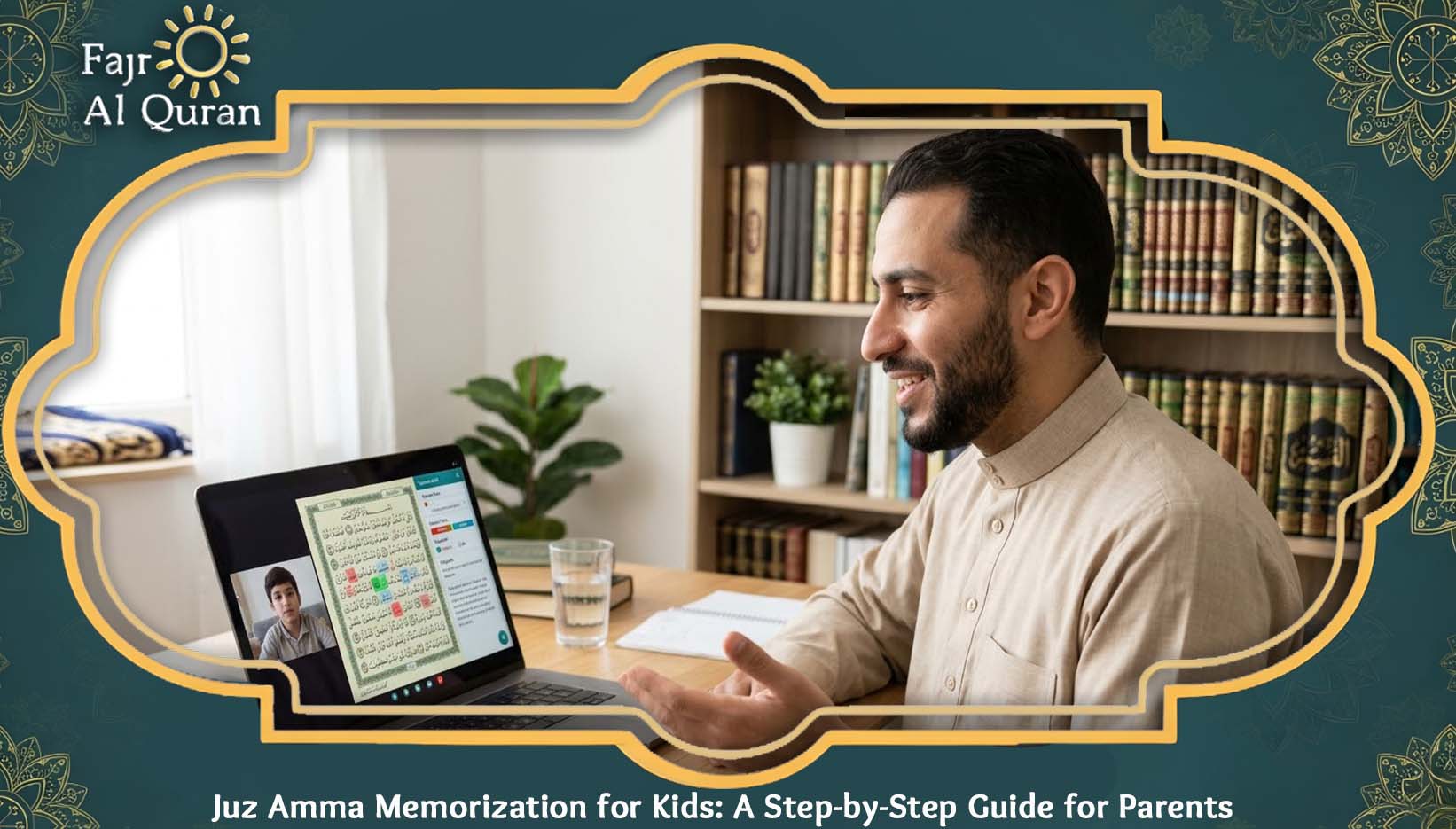
Use a laptop or tablet on a stable surface, keep the space quiet, and stay nearby for younger children. Test your audio beforehand, and keep a Quran and a glass of water ready so the lesson is not interrupted.
Red Flags to Avoid
Be cautious of pre-recorded-only courses with no live feedback, teachers who cannot explain their qualifications, unrealistic promises (such as completing the Quran in a few weeks), and programs with no way to track progress.

How Fajr Al-Quran Academy teaches Juz Amma memorization for kids
At Fajr Al-Quran Academy, we support families who want a gentle, structured path through Juz Amma.
One-on-One Live Lessons With Qualified Tutors for Juz Amma memorization for kids
Each child learns with a dedicated tutor who listens, corrects, and adapts the pace to their ability. One-on-one attention means no child is left behind, and no mistake goes unnoticed.
Teaching Methods for Juz Amma memorization for kids</h3>
Our tutors use age-appropriate activities, regular revision, and clear progress tracking to keep children engaged and confident. Lessons are warm and encouraging, never harsh.
Flexible Scheduling: Juz Amma memorization for kids for US, UK, Canada, and Australia Time Zones
Choose lesson times that fit your family’s routine, whether that is early morning before school, after school, or on weekends.
Progress Reports and Parent Involvement
Parents stay informed about what has been memorized, what needs revision, and what comes next, so you can support your child at home with confidence.
Free Trial Class
The best way to know if we are the right fit is to experience a lesson. Book a free trial class and meet a tutor who can assess your child’s level and suggest a personalized Juz Amma plan.
Frequently Asked Questions About Juz Amma Memorization for Kids
How long does it take to memorize Juz Amma for Kids?
Most children take several months to a year or more, depending on age, consistency, and support. A child practicing 15-20 minutes daily with regular revision typically progresses steadily. Focus on accuracy and retention rather than speed.
What age should a child start memorizing Quran?
Children can start listening and repeating short surahs from about age three or four. Structured memorization often works well from ages six to eight, though older children can begin successfully at any age.
Which surah should my child memorize first?
Most teachers recommend starting with short surahs such as An-Nas, Al-Falaq, and Al-Ikhlas. They are easy to learn, widely used in prayer, and give children early confidence.
How many minutes a day should kids memorize Quran?
Fifteen to twenty minutes of focused practice is a good target for most children, including revision. Younger children may do well with shorter sessions of about ten minutes.
Is online Quran memorization effective for kids?
Yes, when lessons are live, one-on-one, and taught by qualified teachers who provide real-time correction. Online learning also offers flexibility that busy Western families often need.
Conclusion: Start Your Child’s Juz Amma Journey Today
Helping your child memorize Juz Amma is one of the most meaningful gifts you can give. Start small, stay consistent, prioritize correct tajweed, and make revision a daily habit. Celebrate every surah, and remember that every step, however small, is rewarded.
You do not have to do it alone. Book a free trial class with Fajr Al-Quran Academy and take the first step toward a lifelong bond between your child and the Book of Allah.