Arabic for Non-Native Speakers: A Complete Beginner’s Guide
@Learning Arabic for Non-Native Speakers focuses on foundational grammar, vocabulary, pronunciation, and cultural context. However, modern resources such as structured courses and online communities make it increasingly accessible. For formal communication, focus on Modern Standard Arabic (MSA), while regional dialects (e.g., Egyptian, Levantine) are useful for daily interaction. Consistent practice, exposure through media, and cultural immersion significantly enhance proficiency. Many learners benefit from blending grammar study with real-life conversation opportunities.
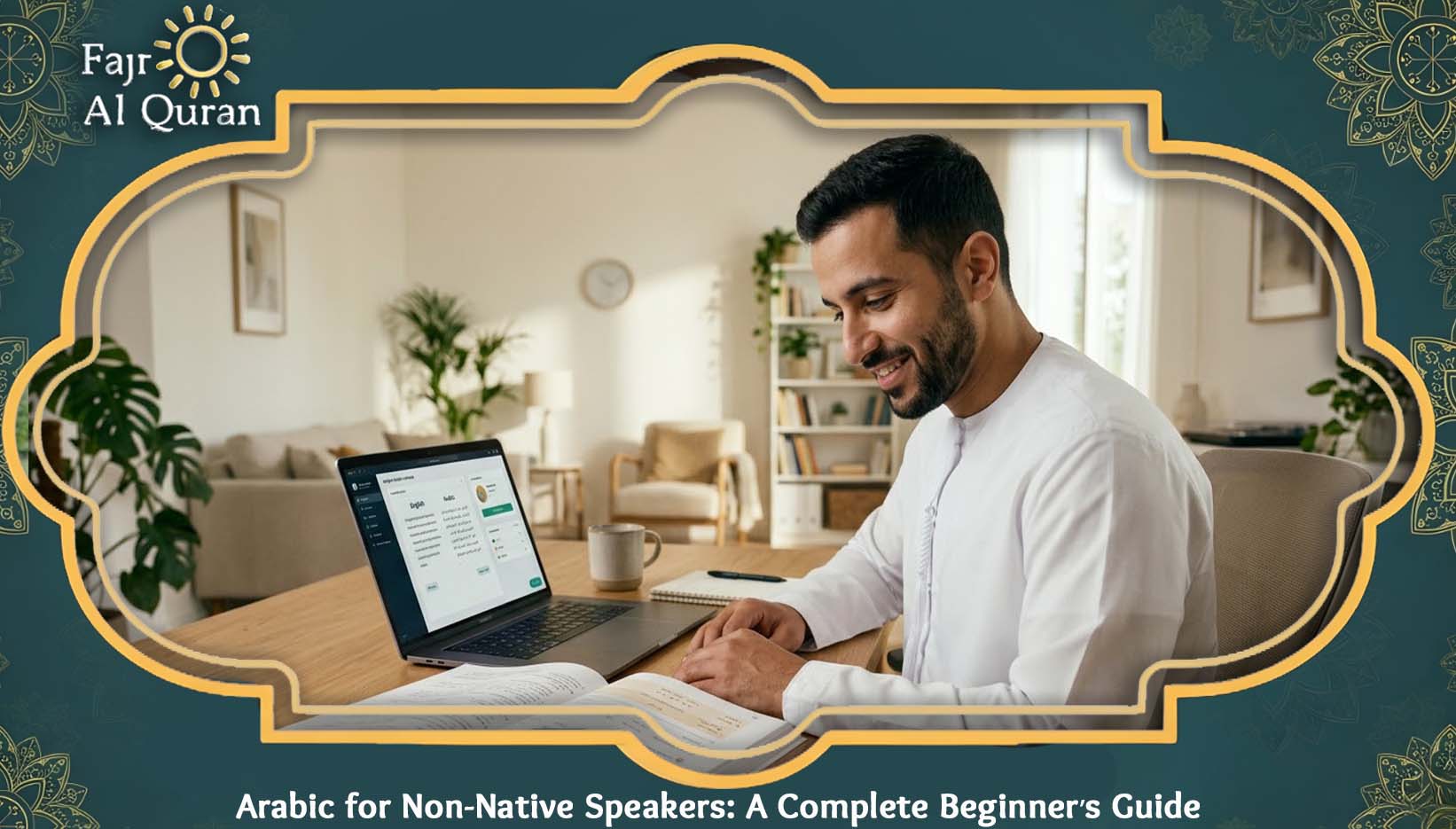
Learning Arabic for non-native speakers can feel challenging at first, especially if you have never studied a language with a different alphabet, unfamiliar sounds, and several spoken varieties. However, you do not need previous experience to begin. With a clear learning goal, regular practice, and suitable guidance, you can gradually develop your Arabic reading, writing, listening, and speaking skills.
The first step is choosing the right type of Arabic for your needs. You may want to communicate during travel, study at university, understand Arabic media, help your children learn their heritage language, or understand the Quran and Islamic prayers more deeply. Each goal requires a slightly different approach.
This complete beginner’s guide explains which Arabic to learn, the essential language skills to develop, realistic learning timelines, and how to choose an effective course or teacher. It also provides a practical learning plan you can follow from home.
Who is this guide for? Adults, parents, international students, complete beginners, and Muslim learners in the USA, UK, Canada, and Australia who want a structured introduction to Arabic.
Why Do Non-Native Speakers Learn Arabic?
Your reason for learning shapes which lessons, resources, and activities will help most.
Communication and travel
Arabic helps you talk with people across the Arab world and handle everyday situations while traveling. Greetings, numbers, directions, food vocabulary, and common questions are a practical starting point. If you plan to visit Egypt, Egyptian Arabic will serve you best in shops, restaurants,s and taxis; if you often visit another region, its local dialect is the better choice.
Education and career
Students learn Arabic for university programs, research, examinations, or study abroad. MSA is especially useful for formal reading, writing, and news. Arabic also supports work in translation, international relations, diplomacy, business, and humanitarian organizations; the level you need depends on the role.
Culture and media
Arabic opens a rich literary and cultural heritage, including film, music, history and poetry. Most learners combine formal Arabic with the spoken dialect of the media they enjoy.
Religious understanding
For non-Arab Muslims, Arabic can support Quran reading, understanding common prayer expressions,s and exploring Islamic texts. Beginners usually start with the alphabet, pronunciation, and frequently encountered Quranic vocabulary before moving on to grammar.
Is Arabic Difficult for Non-Native Speakers?
Arabic is challenging for English speakers, but difficult does not mean out of reach. Your experience depends on your first language, previous language learning, study habits, instruction,n and the level you want to reach.
What makes Arabic challenging?
- Script: Arabic is written from right to left, and letters change shape depending on their position in a word.
- Vowels: Short vowel marks, called harakat, are usually written in beginner materials and the Quran but omitted in most everyday texts.
- Sounds: Sounds such as ع (ayn), ح (h, a), and ق (qaf) have no direct English equivalent.
- Grammar: Grammatical gender, word-formation patterns, and sentence structure differ from English.
- Formal and spoken Arabic: The Arabic in textbooks differs from everyday speech.
What makes Arabic easier than expected?
Arabic is highly patterned. Once you know the alphabet and how letters connect, you can sound out unfamiliar words. Many words are built from three-letter roots. The root ك-ت-ب (k-t-b), connected with writing, gives kitab (book), kataba (he wrote), maktab (office or desk), and katib (writer). Learning roots lets you guess related words instead of memorizing each one separately.
How Long Does It Take to Learn Arabic?
There is no single timeline. Reading simple words, introducing yourself, holding everyday conversations,s and working in Arabic are different goals.
The US Foreign Service Institute places Arabic in its most demanding category for English-speaking diplomats and estimates about 88 weeks, or roughly 2,200 class hours, to reach professional working proficiency. That figure describes intensive full-time training. It is not a prediction for a casual learner and not a requirement for basic Arabic. Most beginners can read simple words and introduce themselves long before that.
A useful way to plan is by weekly time. Thirty minutes a day is about 3.5 hours a week and roughly 180 hours a year; one hour a day is about 365 hours a year. Consistency matters more than the occasional long session.
Types of Arabic for Non-Native Speakers: Which One Should You Learn?
Arabic as a foreign language (AFL), sometimes called Arabic for foreigners, is usually taught as one of three forms. They share a foundation but serve different purposes.
Modern Standard Arabic (MSA)
Fusha (فصحى), meaning “most eloquent”, is the general term for formal Arabic, including Classical Arabic; MSA is its modern form. MSA is used in news broadcasts, books, education, and official communication. It suits learners who want to read, study academic material, or build a broad foundation. It is not the language most people speak at home.
Spoken Arabic dialects
Dialects differ in pronunciation, vocabulary, and grammar.
- Egyptian Arabic: widely understood thanks to Egyptian film and television.
- Levantine Arabic: everyday speech in Lebanon, Jordan, Palestine and Syria.
- Gulf Arabic: varieties spoken in the Gulf countries.
- Maghrebi Arabic: varieties in Morocco, Algeria and Tunisia.
Learning MSA alone will not fully prepare you for informal conversation in any of these.
Quranic and Classical Arabic for non-native speakers
Quranic Arabic is the language of the Quran. Classical Arabic also covers historical texts and traditional Islamic scholarship. Both share much with MSA, but vocabulary, style,e and usage differ in places. Quran recitation also involves tajweed, the discipline of correct pronunciation and recitation, which general Arabic study does not replace.
MSA or a dialect first?
Choose by what you want to do in the first year, and avoid mixing varieties in your first weeks.
| Your main goal | Start with | Add later |
|---|---|---|
| Chatting with people in a specific country | That country’s dialect | MSA for reading |
| University study, research or formal writing | MSA | A dialect for conversation |
| Understanding the Quran | Alphabet and reading, then Quranic vocabulary and grammar | MSA, and separate tajweed instruction |
| Careers in translation or diplomacy | MSA | One or more dialects |
| Helping children with a heritage language | Age-appropriate MSA or the family dialect | The other variety |
This is an editorial recommendation, not a rule; many programs teach MSA and a dialect together.
Essential Arabic Skills Every Beginner Needs
A balanced course develops several connected skills, not just vocabulary. Reading, writing, pronunciation, grammar, listening, and speaking reinforce one another.
The Arabic alphabet and script for non-native speakers
Arabic has 28 basic letters and is written from right to left. Most letters change shape depending on whether they stand alone or connect within a word. Take the letter ب (ba):
- Isolated: ب
- Initial: بـ
- Medial: ـبـ
- Final: ـب
One rule saves beginners a lot of confusion: six letters (ا د ذ ر ز و) connect to the letter before them but not to the one after, so the next letter starts a new shape. Learn a few letters at a time, then practice connecting them into simple words.
Short vowels are written as small marks above or below a letter. With ب, a fatha gives بَ (ba), a kasra gives بِ (bi), and a damma gives بُ (bu). Start with fully vowelled words and remove the support gradually.
Arabic pronunciation
Similar-looking or similar-sounding letters can represent different sounds, so accuracy matters from the start. Three areas need particular attention:
- Throat sounds: ع (ayn) and ح (ha) come from deep in the throat. Distinguish ح from the lighter ه (ha).
- Emphatic letters: ص ض ط ظ are pronounced with a fuller, heavier tongue position than their plain counterparts س د ت ذ.
- ق (qaf): produced further back in the mouth than English k.
A teacher can help you practice makharij, the articulation points of Arabic letters. Clear recordings and short repeated words reinforce the work between lessons.
Arabic vocabulary for beginners
Begin with words that match your goal: greetings, numbers, family terms, everyday objects, ts and common verbs. Notice roots and patterns instead of memorizing words in isolation. These common Arabic phrases make a good first set:
| English | Arabic | Pronunciation |
|---|---|---|
| Hello / welcome | مرحباً | marhaban |
| Peace be upon you | السلام عليكم | as-salamu alaykum |
| Thank you | شكراً | shukran |
| Please | من فضلك | min fadlika (to a man), min fadliki (to a woman) |
| Yes / No | نعم / لا | na‘am / la |
| My name is… | اسمي … | ismi… |
| How are you? | كيف حالك؟ | kayfa haluka? (to a man), kayfa haluki? (to a woman) |
| Where is…? | أين …؟ | ayna…? |
Arabic grammar basics for non-native speakers
Arabic grammar for non-native speakers includes noun and verb forms, grammatical gender, sentence structure, and the definite article ال (al-), which usually corresponds to “the.” A simple sentence shows the pattern: هذا كتاب (hatha kitab) means “This is a book.” Learn grammar gradually and use each new pattern in short sentences of your own before moving on.
Reading and writing Arabic for non-native speakers
Start reading and writing Arabic for non-native speakers with short, fully vowelled words and simple sentences. Write letters individually before connecting them, and read aloud to link spelling with sound. Then move to short passages and simple dialogues that fit your goal.
Listening and speaking
Listening trains you to recognize words at natural speed; speaking helps you retrieve vocabulary and use grammar in real situations. Start with short recordings and repeated phrases, then practice introducing yourself, asking directions, or describing familiar objects. You do not need perfect grammar before you speak.
| Skill | Why it matters | Beginner tip |
|---|---|---|
| Alphabet and script | Supports reading and writing | Learn a few letters daily |
| Pronunciation | Builds clear, accurate speech | Practice with corrective feedback |
| Vocabulary | Helps you understand and express meaning | Review useful words in sentences |
| Grammar | Helps you form meaningful sentences | Study one pattern at a time |
| Reading and writing | Develops literacy | Start with short, vowelled texts |
| Listening and speaking | Builds practical communication | Repeat short dialogues aloud |
A Step-by-Step Arabic Learning Plan for Beginners
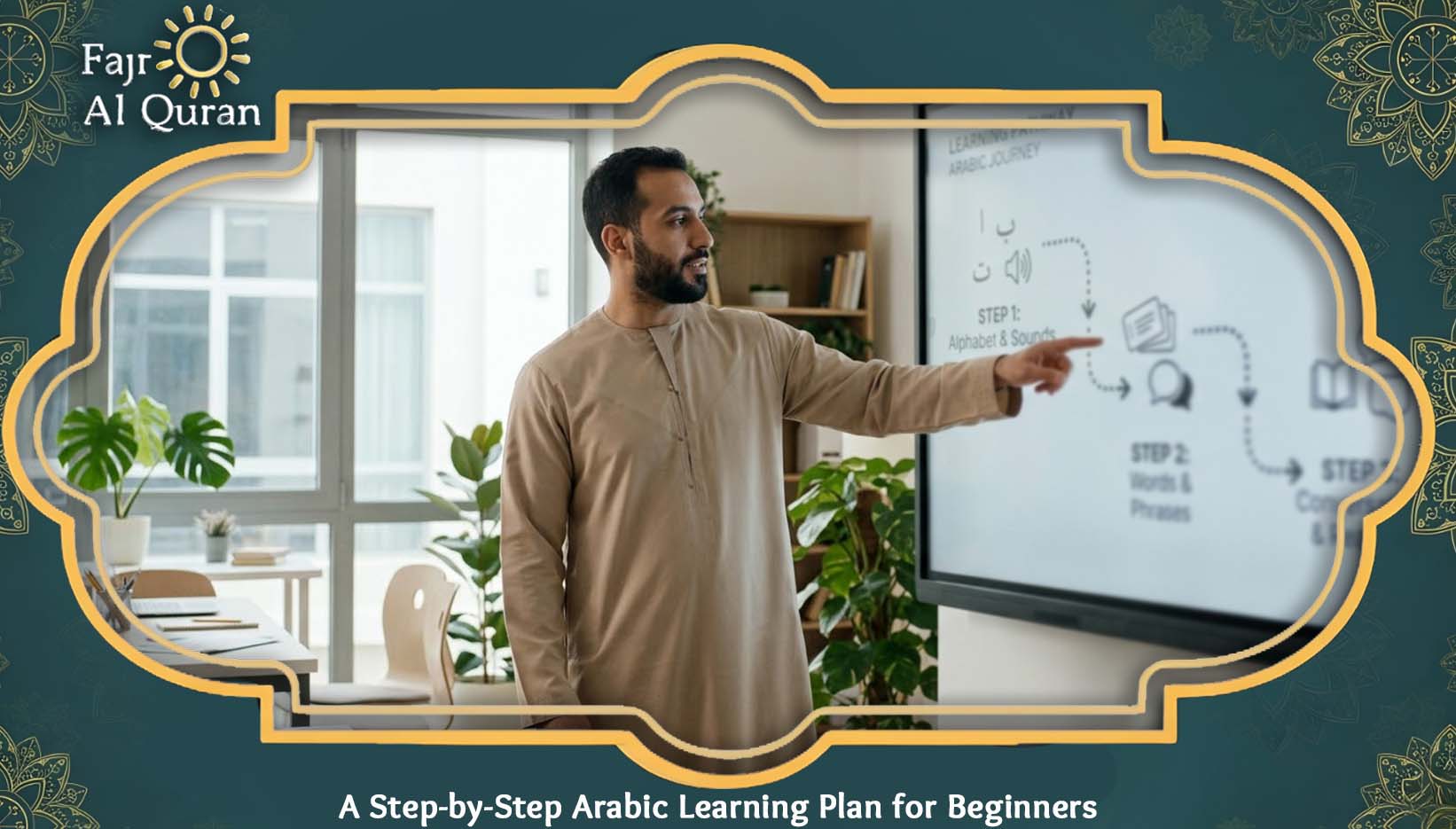
This roadmap is a flexible example, not a guaranteed timetable.
- Define your goal. Decide between conversation, MSA for study,y or Quranic Arabic. Your goal decides which vocabulary and texts come first.
- Learn the alphabet and short vowels. Practice letter names, shapes, and connections inside simple words, not as isolated symbols.
- Work on pronunciation. Listen, repeat, and ask a qualified teacher to correct mistakes early, especially with sounds that have no English equivalent.
- Build core vocabulary. Choose words from your daily life and goals. Ten to fifteen new words a week is a manageable starting target; adjust to what you can remember and use.
- Learn simple sentences and grammar. Practice basic noun sentences, common verbs, questions,s and short answers.
- Read and listen regularly. Use beginner passages, short dialogues and slow audio, and revisit familiar material.
- Start speaking. Practice greetings, introductions, and short conversations with a teacher or language partner.
- Review monthly. Check vocabulary, reading accuracy, pronunciation, and your ability to complete simple tasks, then adjust.
A sample 12-week Arabic roadmap for beginners
| Period | Suggested focus | Progress to look for |
|---|---|---|
| Weeks 1–2 | Letter recognition and sounds | Recognize letters and begin pronunciation practice |
| Weeks 3–4 | Letter connections and short vowels | Read simple, fully vowelled words |
| Weeks 5–6 | Core vocabulary and everyday expressions | Understand and use familiar words |
| Weeks 7–8 | Basic grammar and sentence patterns | Form short sentences and simple questions |
| Weeks 9–10 | Beginner reading and listening | Follow short, familiar dialogues or passages |
| Weeks 11–12 | Speaking practice and revision | Complete simple tasks suited to your goal |
These milestones are illustrative. Progress depends on lesson frequency, prior knowledge,e and practice. Someone studying Quranic Arabic, for example, may spend longer on accurate reading and pronunciation before moving to vocabulary and grammar.
Best Way to Learn Arabic as an English Speaker
The best way to learn Arabic with the Quran for non-native speakers is the one you will keep using, and that fits your goal. Most learners do best with a mix.
| Option | Works well for | Limitations |
|---|---|---|
| Self-study (apps, books, video, audio) | Starting from scratch on a low budget; building a daily habit | No one corrects pronunciation or writing; easy to stall |
| Group classes | Structure, a fixed schedule,e and peer practice | Less individual feedback; pace is set for the group |
| Private online tutor | Personal feedback, a flexible schedule, goal-specific lessons | Usually costs more; quality depends on the teacher |
University-style textbooks such as Al-Kitaab focus on MSA, while the Madinah Arabic Course is widely used by learners with Islamic study goals. Whichever route you choose, add listening practice and regular speaking, even if only a few minutes a day.
Why Learn Arabic with a Qualified Teacher for non-native speakers?
A qualified teacher helps you avoid common beginner mistakes and follow a coherent path from foundations to practical use.
- Accurate pronunciation: A teacher models sounds, listens to your attempts, and explains how to adjust your articulation.
- A structured path: A curriculum with levels and revision beats jumping between apps and videos.
- Personalized Arabic lessons: Adults, children, students, and Muslim learners have different priorities, and a teacher can focus on conversation, academic reading,g or Quranic language.
- Accountability: Regular lessons build a routine, and feedback helps you notice progress.
Common Challenges and How to Overcome Them
| Challenge | Practical solution |
|---|---|
| The script looks impossible | Learn a small group of letters at a time and write them daily |
| Certain sounds are difficult | Listen to clear examples, repeat slowly, and ask for teacher feedback |
| MSA and dialects feel confusing | Choose one main path before adding another |
| Vocabulary disappears | Use spaced repetition and practice words in sentences |
| Grammar feels overwhelming | Learn one pattern at a time and apply it in short examples |
| Motivation drops | Set small weekly goals and keep a realistic routine |
| Listening feels too fast | Start with short, slow recordings and repeat familiar material |
Do not compare yourself with fluent speakers. Someone who grew up hearing Arabic has had years of exposure that a beginner has not. Compare your abilities with your own earlier performance, and if a problem persists, ask your teacher to explain it differently or provide extra practice.
How to Choose the Right Arabic Course or Program for non-native speakers
An Arabic course for non-native speakers should match your goal, level, schedule, and budget. A polished website alone does not show that a course will meet your needs. Before enrolling, check:
- Teacher qualifications: relevant teaching experience, ideally with non-native speakers.
- Clear curriculum: levels, learning sequence, materials,s and expected skills.
- Goal-specific content: MSA, a dialect, Quranic Arabic, or a combination.
- Class format: private lessons or small groups, depending on how much individual feedback you need.
- Flexible scheduling: lesson times that suit your time zone in the USA, UK, Canada, or Australia.
- Progress tracking: how teachers assess pronunciation, reading, vocabulary, grammar, and speaking.
- Transparent terms: prices, payment arrangements, cancellation policy, and any trial or enrollment conditions.
Red flags to watch
Be cautious if a provider gives no meaningful information about its teachers, cannot explain its curriculum, or promises guaranteed fluency in an unrealistic time. Unclear fees, pressure to pay before you understand the program, and lessons that ignore your stated goals are also warning signs. Before committing, ask whether the teacher can support a complete beginner, how progress is measured, what happens if you need to reschedule, and whether you can see sample materials or discuss your goals first.
Online Arabic Lessons for Kids, Adults and Muslim Learners
Online Arabic lessons make structured learning accessible to people who cannot easily attend a local class. Results still depend on lesson quality, materials, regular practice, and a format that suits the learner.
Arabic for kids
Children do best with age-appropriate lessons, clear routines, patient teaching, and activities that keep them engaged. Short exercises, visuals, repetition,n and simple conversations help without overwhelming them. Parents should ask about teacher experience, lesson structure, online safety, and how progress is reported, and younger children may benefit from brief, supervised practice between lessons.
Arabic for adults
Adults usually balance learning with work and family, so flexible scheduling and clearly defined goals matter. A traveler may focus on greetings and everyday conversation, a university student on MSA, reading and formal writing, and someone learning for personal development on a mix of practical skills and culture.
Arabic for non-Arab Muslims
Muslim learners often want to read the Quran with more confidence, understand expressions used in Salah, or explore Quranic vocabulary. It helps to separate three goals, because each needs different practice:
- Reading the Arabic script so you can read the Quran.
- Understanding Arabic through vocabulary and grammar.
- Reciting correctly through tajweed, which needs its own focused instruction with a qualified teacher.
How to learn Quranic Arabic as a beginner:
- Learn the Arabic alphabet, letter shapes,s and short vowels.
- Practice accurate pronunciation and basic reading with feedback.
- Learn high-frequency words you meet often in the Quran and in prayer.
- Add foundational Arabic grammar: noun and verb forms, sentence structure, and the definite article.
- Read short, familiar passages with a teacher and study meaning alongside recitation.
This order is a common teaching sequence, not a religious ruling. Ask your teacher to adapt it to your starting level.
Learning Arabic for non-native speakers online from the USA, UK, Canada, or Australia
Online lessons let you study with teachers based elsewhere, which widens your choice. Before choosing a program, confirm lesson times for your time zone, the teaching language, class format,t and payment terms.
Learning Arabic for non-native speakers online with Fajr Al-Quran Academy
Fajr Al-Quran Academy is one online option for beginners exploring Arabic and Quran-related study. According to its website, it offers Arabic language programs covering listening, speaking, reading, writing, ng and grammar, adapted to the student’s age and level, as well as Quranic Arabic study for learners who want to understand Quranic vocabulary and foundational grammar. It also mentions flexible scheduling and a free trial class. Check current details on the academy’s official website and ask how lessons would be adapted to your level and goal before enrolling.
Frequently Asked Questions
Is Arabic hard for non-native speakers?
Arabic takes time because of its script, pronunciation, grammar, and regional varieties. Beginners can still make steady progress with structured lessons and consistent practice.
How long does it take to learn Arabic for non-native speakers?
It depends on your goal, study frequency, experience, and method. Reading basic words takes far less time than conversational or professional proficiency; the FSI’s 2,200-hour figure refers to intensive professional training.
Is Quranic Arabic different from Modern Standard Arabic?
They share many features, but vocabulary, style, and usage differ in places. Quranic Arabic focuses on the language of the Quran, while MSA is used for modern formal communication.
What is the best way to learn Arabic for non-native speakers?
Choose your goal, learn the alphabet and pronunciation, build useful vocabulary, and practice simple sentences. Combine structured lessons or a tutor with regular independent revision.
Can I learn Arabic from scratch online?
Yes. Online lessons and self-study both work for complete beginners. Feedback on pronunciation is the main thing self-study cannot easily provide.
Can children learn Arabic online?
Yes, when the teaching approach, materials, class length, and supervision suit their age. Parents should check teacher suitability and online safety.
Conclusion: Your Next Steps
Learning Arabic as a non-native speaker becomes manageable when you start with a clear goal and follow a structured plan. Decide whether you need conversational Arabic, Modern Standard Arabic, or Quranic Arabic, then build the alphabet, pronunciation, vocabulary, grammar, reading, listening, and speaking skills in that order of priority. You do not need to master everything at once.
If you prefer guided lessons, you can review the programs offered by Fajr Al-Quran Academy or contact the academy to discuss your goals before enrolling.
Start with one small step today: learn three letters, practice one phrase from the table above, or put a weekly study session in your calendar.